Earn $10 back in Zuture Wallet • Online orders only ✓
Need guidance? Contact sales
Perpetual license
Lifetime support
Free updates
30-day exchange
Earn $10 back in Zuture Wallet • Online orders only ✓
Part of a broad trading intelligence ecosystem comprising 300+ research projects and products.
Trusted by
60,000+ traders
worldwide
Reflected in
700+ verified
5-star reviews
Backed by
12 years of
research & innovation
Read ABCD waves through rules, not by eye
Identify continuation and reversal setups through consistent rules for swing detection, real-time pattern validation, and signal confirmation.
Why the ABCD pattern matters
Most indicators derive their readings from price data. The ABCD pattern takes a different approach: it reads the swing highs and lows that define how price moves, where momentum stalls, and when buyers or sellers regain control.
Every point has a trading purpose:
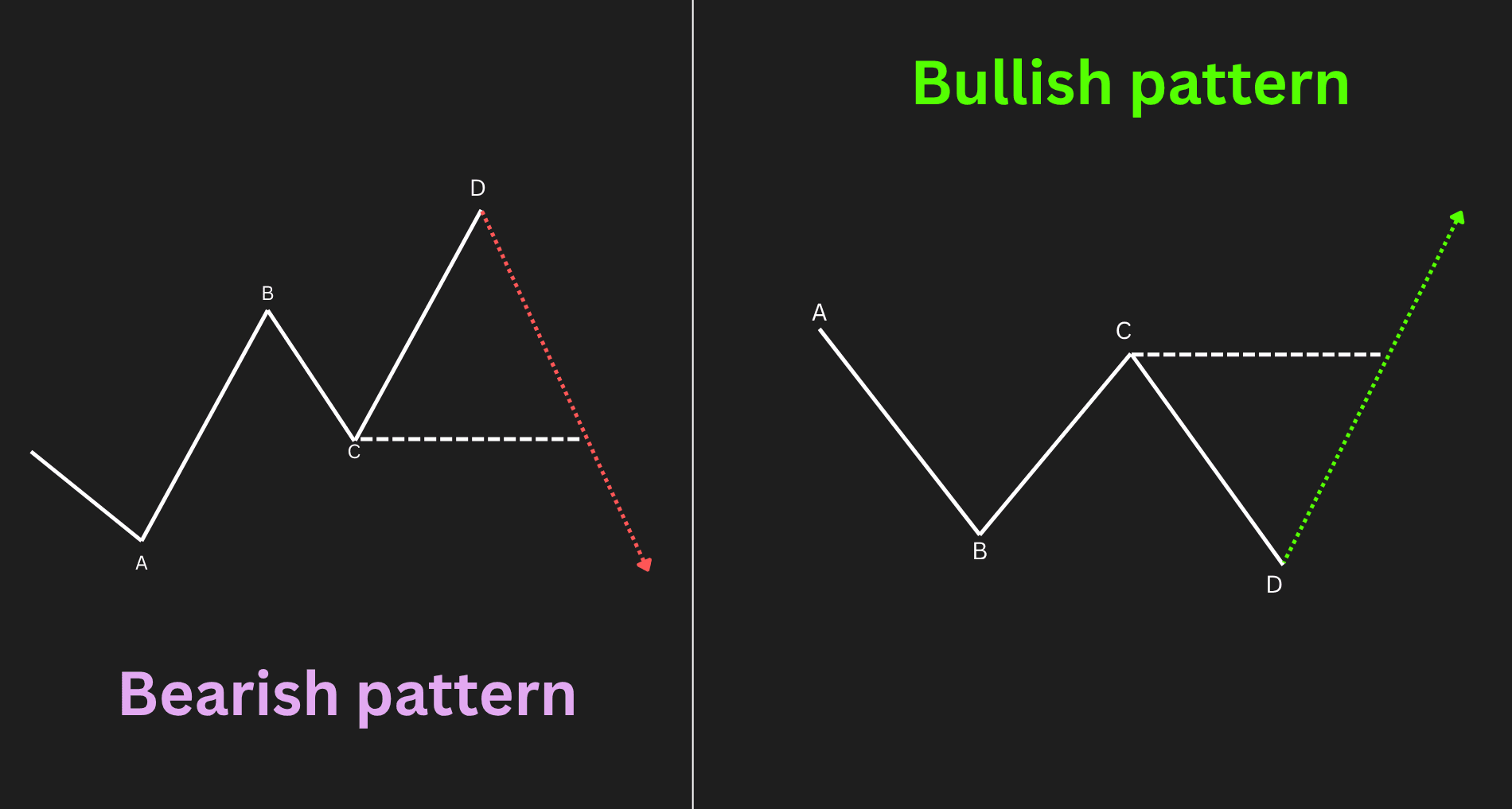
A – Reference: Establishes the previous swing high.
B – Invalidation: Defines where the bullish structure breaks down.
C – Confirmation: A close above the previous high confirms continuation.
D – Entry Zone: Identifies the pullback area to watch for entry confirmation.
The same structural framework helps you identify continuation and reversal setups without switching between different methods as market conditions change.
3 ways SwingWeave improves ABCD pattern analysis
1. Eliminate inconsistency in swing detection
On intraday charts, especially lower timeframes like the 2-minute NQ, multiple highs and lows can form close together. When traders identify swings differently, the same chart can produce different market structures and setup evaluations.
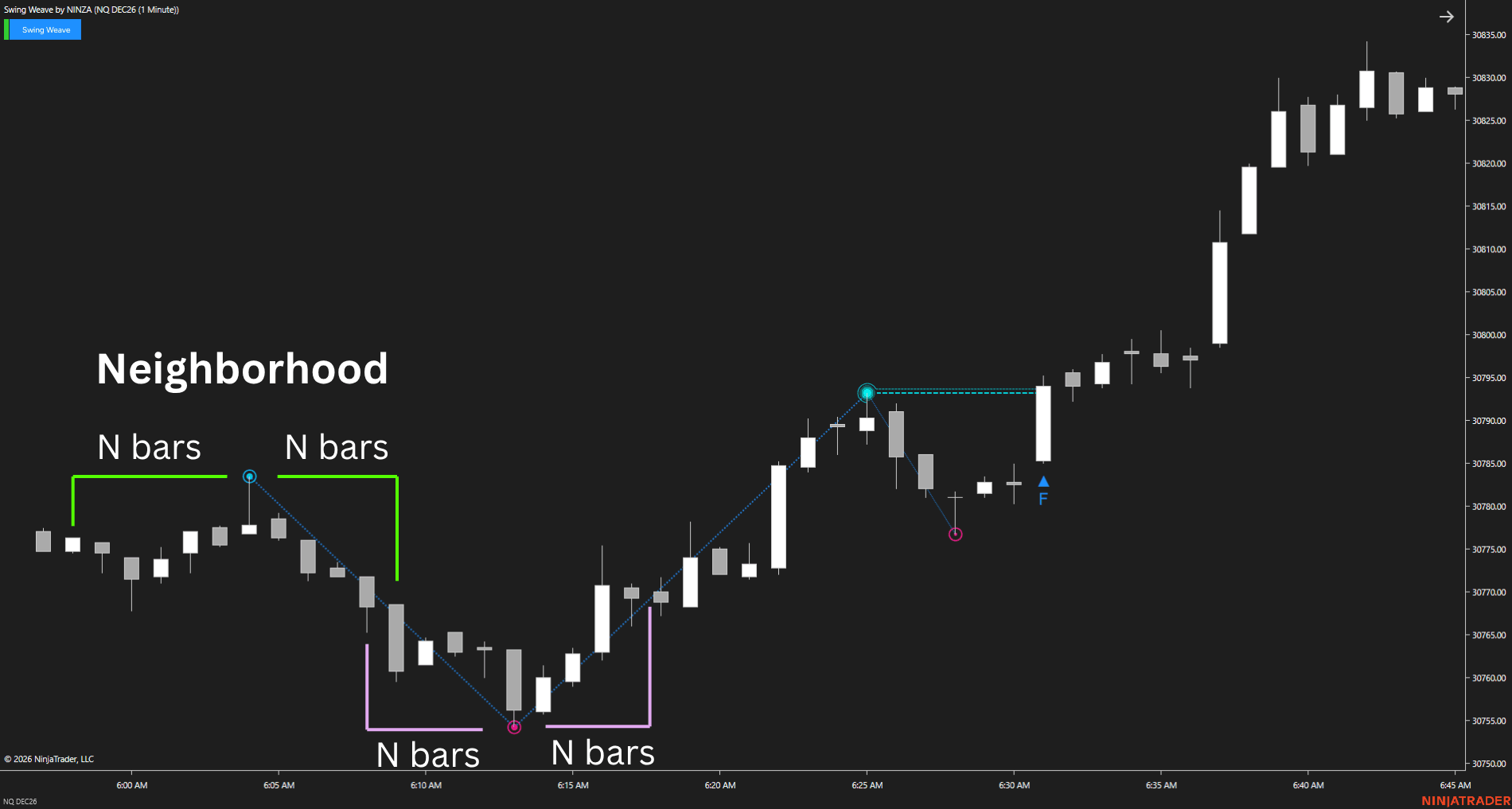
SwingWeave uses the Neighborhood setting to define swing points through consistent rules:
5 bars on each side by default, confirming a swing high only after five bars to the right have closed.
Flat highs are consolidated into a single swing point, with shallow pullbacks handled by defined rules.
The same chart and settings produce the same swing structure, giving you a consistent basis for evaluating setups across sessions.
Once A–B–C has formed, SwingWeave tracks price extremes with each new bar to update point D.
A pattern is removed when:
The structure is invalidated. D moves beyond B, invalidating the Follow setup.
The pattern expires. Price fails to close beyond C within the Pattern Age limit, set to 20 bars after C by default.
A pattern that looks compelling in historical data may no longer be valid after multiple bars without confirmation. SwingWeave keeps the chart focused on patterns that remain valid under your predefined rules.
3. Confirm signals at candle close
SwingWeave does not generate a signal simply because price touches or temporarily breaks beyond C while a candle is still forming.
It waits for the candle to close beyond the confirmation level. Once a signal appears on a closed candle, it remains fixed.
Each signal provides 3 key reference points:
ABCD Structure – The pattern being tracked.
Confirmation Level (C) – The price level that must be cleared at candle close.
Invalidation Level (B) – The reference for setup invalidation and Stop Loss management.
This gives you a clear confirmation rule, removing the need to judge whether an intrabar break above a high or below a low is reliable enough to act on.
Read market structure with greater flexibility
1. Flexible swing recognition – Price Action vs. MA
SwingWeave offers 2 methods for identifying swing points, each shaping the ABCD structures and breakout signals the indicator recognizes.
Criteria
Price Action Method
Moving Average Method
Swing reference
Actual price movements
Moving average movements
Key characteristic
More reliable Swing breakout identification
Better noise filtering
Breakout signal
Focuses on price movements
May appear earlier while reducing noise
Best suited for
Traders who prioritize direct price structure
Traders who want to filter short-term fluctuations
2. Two ways to identify trading setups – Follow & Reverse
ABCD patterns can reveal different market scenarios, from trends that continue in the same direction to potential reversals as price structure changes.
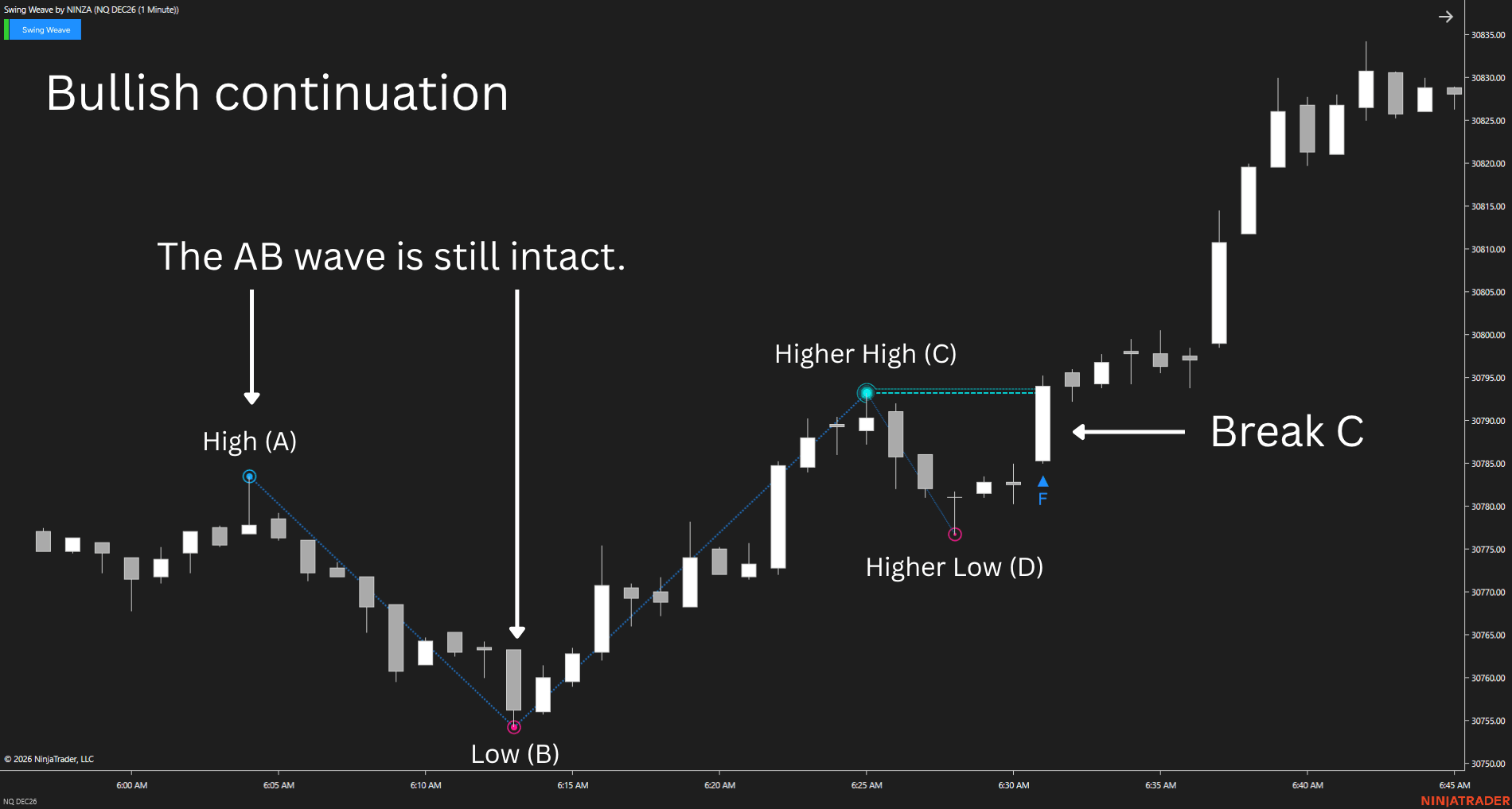
Follow Pattern – Trend Continuation Identifies setups where the existing trend remains intact. After C forms, price pulls back toward D while preserving the structure at B. A candle close beyond C confirms the continuation signal.
Bullish continuation: Higher Highs and Higher Lows.
Bearish continuation: Lower Lows and Lower Highs.
Invalidation: The pattern is canceled if D breaks B in a way that invalidates the structure.
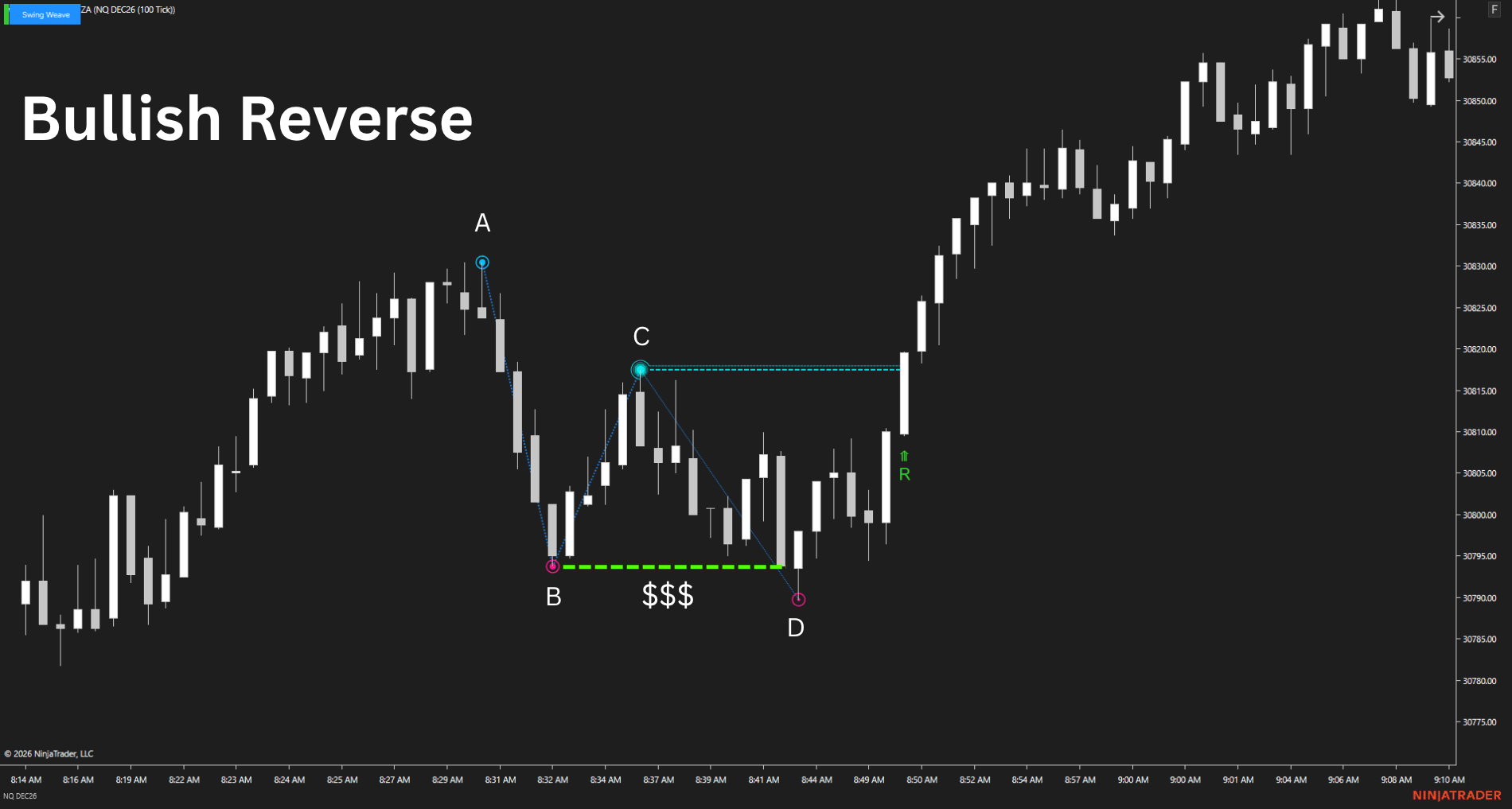
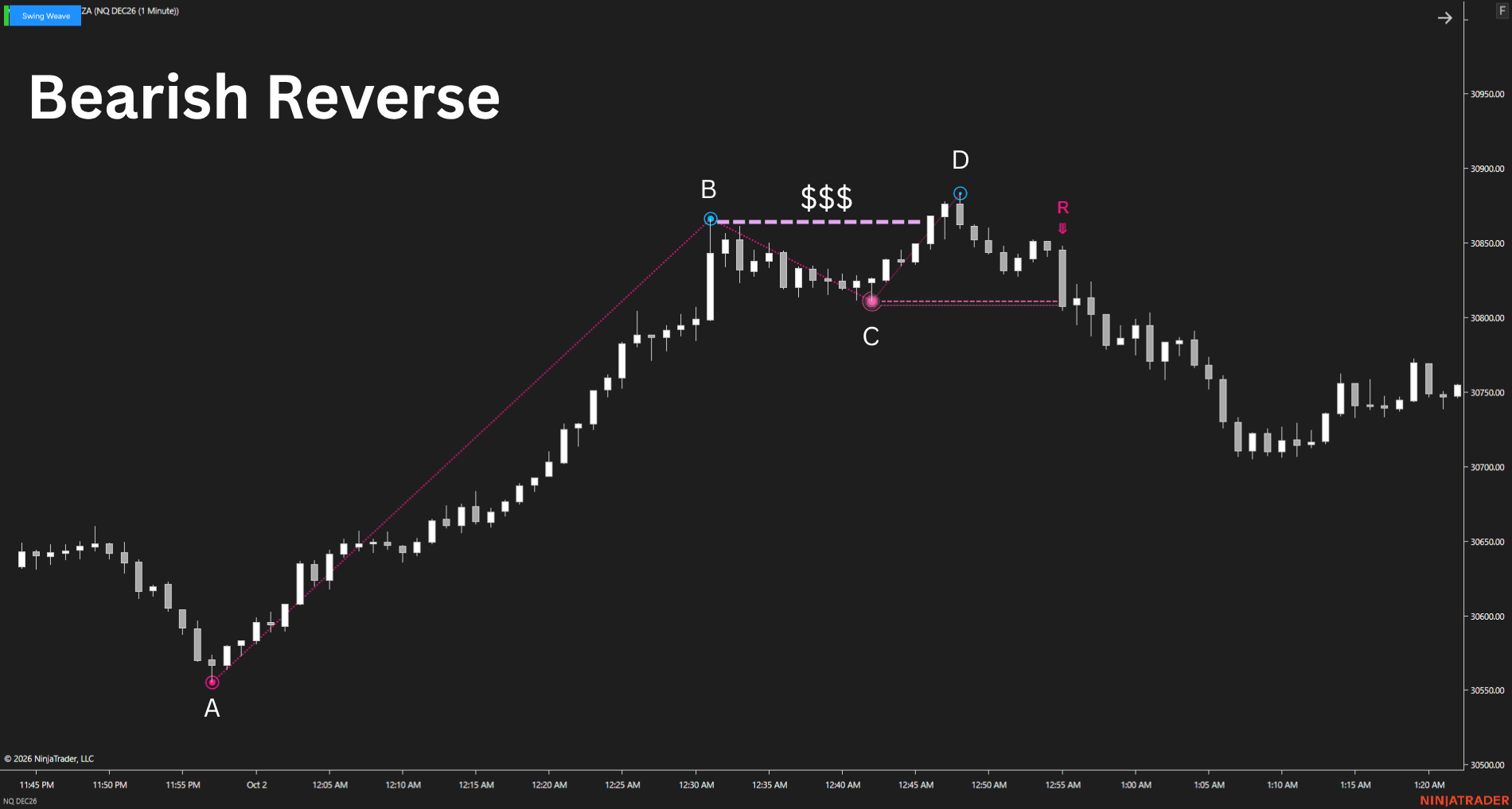
Reverse Pattern – Potential Reversal Identifies potential reversals when price sweeps beyond B, then reverses and closes beyond C in the opposite direction.
Bullish Reverse: Price sweeps to or below B, then closes above C.
Bearish Reverse: Price sweeps to or above B, then closes below C.
These patterns highlight potential shifts in market direction after a liquidity sweep, rather than assuming the existing trend will continue.
Automatically track and validate patterns
Markets don’t wait for you to finish drawing. So SwingWeave keeps working after point C, checking every new candle so you always know whether a setup is still valid.
D moves with price. No more guessing where the pullback will end. When price makes a new low in a bullish setup, D slides down to meet it. A small dot, linked to C by a thin line, shows exactly where the pullback stands right now.
Setups cancel themselves when they’re no longer valid:
Level B is broken: With Pattern Follow, D breaking through B means the structure has failed, so the setup is gone. (Pattern Reverse is the exception: there, a sweep through B is what sets up the signal.)
Pattern age runs out: If 20 candles pass after C without a close beyond it, the setup expires. The default is 20, and you can adjust it. Each pattern gives at most one signal. After the signal, the old swings in the chain are cleared, so the same structure never alerts twice.
The result is a chart that stays focused on valid patterns, without the need to manually check whether each setup is still active.
Watch the indicator in action. Step-by-step guides, live trading, and feature overviews.
Software Changelog
14 Oct 2026:The indicator was released (built new).
Policies
Software license
Every purchase includes a perpetual software license, granting you the right to use the software indefinitely on the number of computers permitted by your license.
Installation & Onboarding
Every purchase includes guided installation assistance. Purchases with Premium Services also include white-glove software setup and onboarding, along with personalized trading setup and workflow optimization.
Software updates & upgrades
Software updates & upgrades are provided at no additional cost. For products with a modular structure, this coverage applies to the core product, while optional expansion modules may be offered separately. Read the full policy
Customer service
Every purchase includes lifetime support via email & chat, delivered by our renowned Customer Care team – widely recognized throughout the trading community for its world-class service. As your NINZA product collection expands, Premium Path unlocks a growing range of enhanced Customer Care benefits & privileges, available through dedicated channels. Explore Premium Path
Remote assistance
Every purchase includes up to 3 complimentary remote assistance sessions, available within 30 days of purchase – with each session lasting up to 30 minutes. Purchases with Premium Services include up to 6 sessions within 60 days of purchase, with priority scheduling and longer session durations.
Product exchange
Customers may request up to 3 product exchanges within 30 days of purchase, at little or no additional cost when exchanging for a comparable product. Read the full policy
Returns & refunds
Due to the ease with which software products can be stored and copied, no returns will be accepted and no refunds will be issued. ALL SALES ARE FINAL & NON-REFUNDABLE.
Community Perspectives
From individual traders to pros and institutional trading teams... Trusted worldwide! Read traders' thoughts
4.9
Based on 800+ authentic reviews
M.
Indicators Improved My Charts. Hannah's Help And Great Customer Service. Will Buy Again.
I have been using the ninZa.co indicators for several months now and am very happy with what a valuable addition they have been to my charts. I recently decided to add one of the recently released indicators from ninZa.co. But after using for a few days, it wasn’t quite what I had been looking for. I contacted ninZa.co and had the pleasure of working with Hannah for an exchange to a different one of the many available indicators. At the time, the indicator I wanted to purchase to replace the one I had recently bought was on sale. Hannah put through an exchange and without my having to ask, gave me the advantage of the sale price. She also included a pdf that provided education about the indicator I chose to switch to. Any time I have had contact with one of the associates from ninZa.co, I have received excellent customer service, and will not hesitate to purchase from them again.
Bartosz
Grace Goes Above And Beyond: A Customer Support Experience That Exceeds Expectations!
Thank You, Grace! Your support is extraordinary I wish all companies have such great support. Keep going I’m 200% satisfied.
Kari L.
ConnorsRSI Pro With Grace's Outstanding Customer Service
Thank you very much for your excellent customer service, Grace! You are doing an excellent job making customers' lives much easier.
T.
An Exemplary Customer Experience At NinZa.Co: Unveiling The Power Of Cumulative Delta
I'm a new customer with ninZa.co and i was needing help today in making a purchase. I made a request on your chat platform and Hannah came to my rescue. She helped me find the what I needed and even offered me a discount. Everything went very smoothly from that point. I made the purchase and she even provided me some documentation on the indicator. I am very pleased with her assistance. Thanks again Hannah for your excellent customer service !!
Mike W.
Smart Ruler
I use ninZa.co's Smart Ruler every day !!! It is on all charts and helps me a great deal. Smart Ruler is one great tool for NinjaTrader !!!!!!!
A. B.
The indicator is working perfectly
The indicator is working perfectly. You guys are the best - Purchased Smart Zoom + Supply/Demand Discovery
Sandeep Rao
Awesome Indicator And Pi Rocks
This is my story, I ordered the Day Range indicator for NIFTY India. To my dismay, it didn't work well as it calculated ranges in ticks. I asked Larry Pi if there was a workaround, and he created a new version with all the choices for range unit: points, ticks, pips. He was with me all through the process, with very short turnaround cycles. So don't hesitate at all to pick what you want! You won't regret.
J.
Grateful For Excellent Support From Hannah!
Hi Hannah, Thank you for your great support. You got back to me right away, provided links to solve the problem, and they worked great! All is well that ends well, and your kind and more than adequate support ended very well! Thanks.
David P. From Connecticut
- Purchased Supply/Demand Discovery + TDI Pro + Solar Wind + Intraday Adaptive S/R + Ruby River + Market Profile (Daily) + Day Range
Just got your new Supply/Demand Discovery and it is truly a great improvement over everything else on the market. It will take me days to determine the best values for the variables for my different charts, but it will be worth the effort.
Research Domains
Full spectrum of trading intelligence across diverse domains. Explore all domains
Volume
See the participation behind price moves
Analyze trading volume to assess market participation and buying or selling pressure. Identify accumulation, distribution, trend confirmation, and notable shifts in market activity.
Analyze real-time buying and selling activity to assess buyer and seller aggression. Help traders gauge the strength behind price movements and identify key shifts in market behavior.

_1787026707358.svg)