
Best Futures Trading Strategies for 2026: 7 Proven Setups (Beginner to Advanced)
Futures trading offers high potential but also high risk without a clear plan. Many beginners are drawn by leverage and volatility in commodities, indices, or currencies, only to face losses after a few poorly managed trades.
That’s why having structured best futures trading strategies for 2026 is essential – they reduce guesswork, protect capital, and provide consistency.
A solid strategy defines entries, stop-loss levels, position sizing, and when to step aside, turning analysis into repeatable execution.
This guide covers beginner strategies like pullbacks, breakouts, and range trading, as well as advanced methods such as order flow, hedging, and algorithmic approaches.
You’ll also learn how risk management, psychology, and capital preservation support consistent results across day and swing trading.
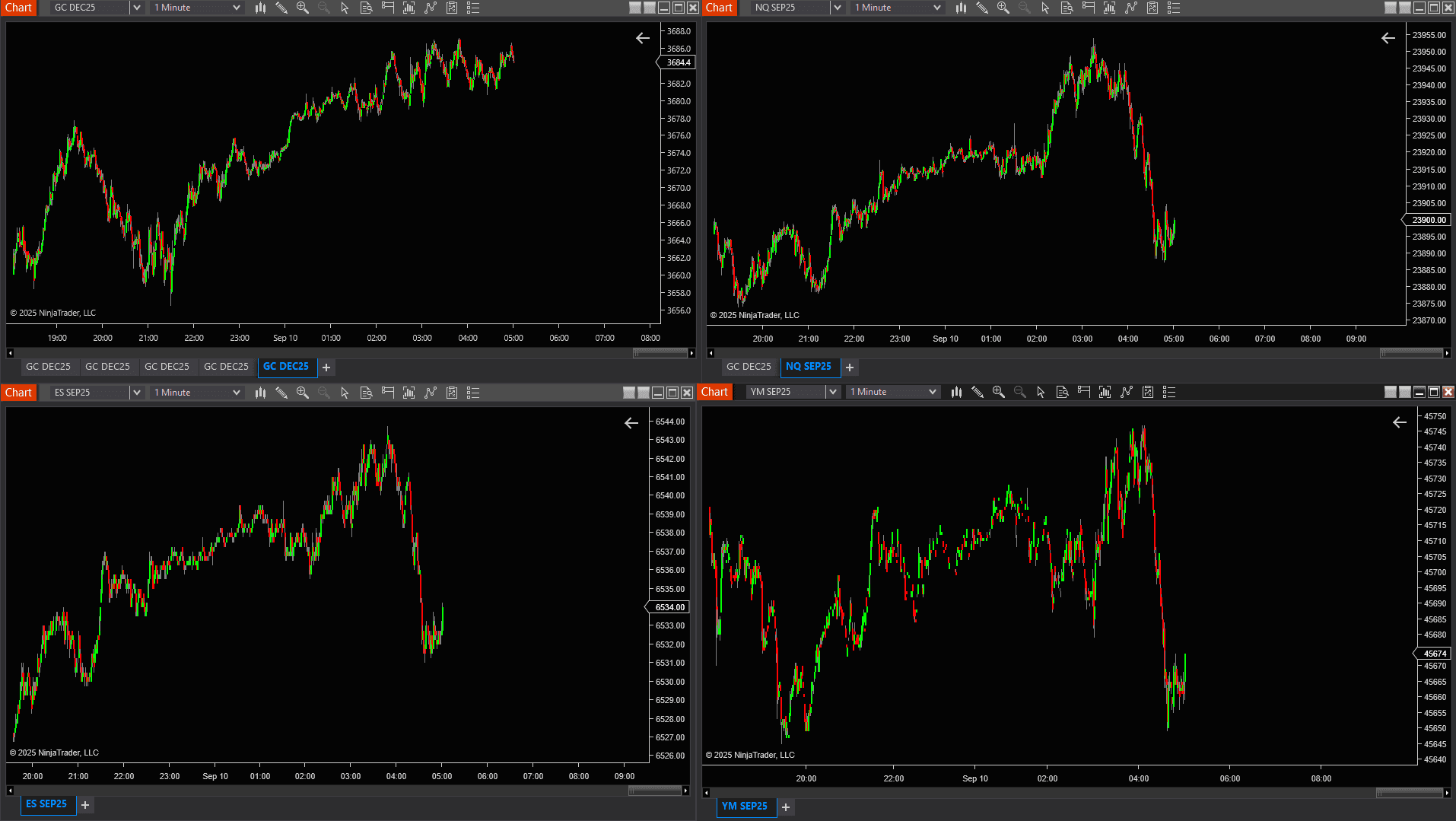
These categories aren’t rigid – you can start with simple techniques like pullbacks or range trading, then gradually layer in advanced tools such as order flow or hedging as your skills grow. Before diving into each method, let’s first step back and look at what makes a good futures trading strategy in the first place.
What makes a good Futures Trading Strategy?
Effective futures strategies share key traits that separate them from random trade ideas. At their core, they provide a repeatable process across different market conditions while protecting capital.
- Clear logic and structure
A strategy should define exactly when to enter, exit, and how much to risk. For example, a day trader on the E-mini S&P 500 might buy the first pullback to the 20 EMA in an uptrend, set a stop under the previous swing low, and target a 2:1 reward-to-risk – simple, repeatable, and rule-based. - Strong risk management
Leverage is a double-edged sword. A solid strategy includes stop-loss placement, position sizing, and a risk-reward ratio. A crude oil trader might risk under 2% of equity per trade and only take setups with at least 2:1 reward-to-risk. - Tested for consistency
Backtesting and forward-testing on historical and real-time data help traders know when a strategy works best. For instance, a breakout system may excel in trending markets but fail in choppy ranges. - Adaptability
Markets shift between trending, ranging, and volatile conditions. Good strategies adapt using filters or adjusting position size, without constantly rewriting rules. - Practical and executable
Complex systems with too many indicators can cause hesitation. Clear, actionable rules ensure trades are executed efficiently under fast-moving market conditions.
Combined, these traits form the foundation of a reliable trading framework that supports both learning and long-term growth.
Best Futures Trading Strategies for Beginners 2026
When you first open a futures chart, it’s easy to feel overwhelmed by the constant ticks, leverage requirements, and fast-moving price swings. The good news is that most successful traders don’t rely on dozens of techniques – they master just a few proven setups that fit their style.
Below are 5 beginner-friendly futures trading strategies that can help you build a structured approach instead of trading on impulse
1. Pullback Trading: Entering after a short-term correction
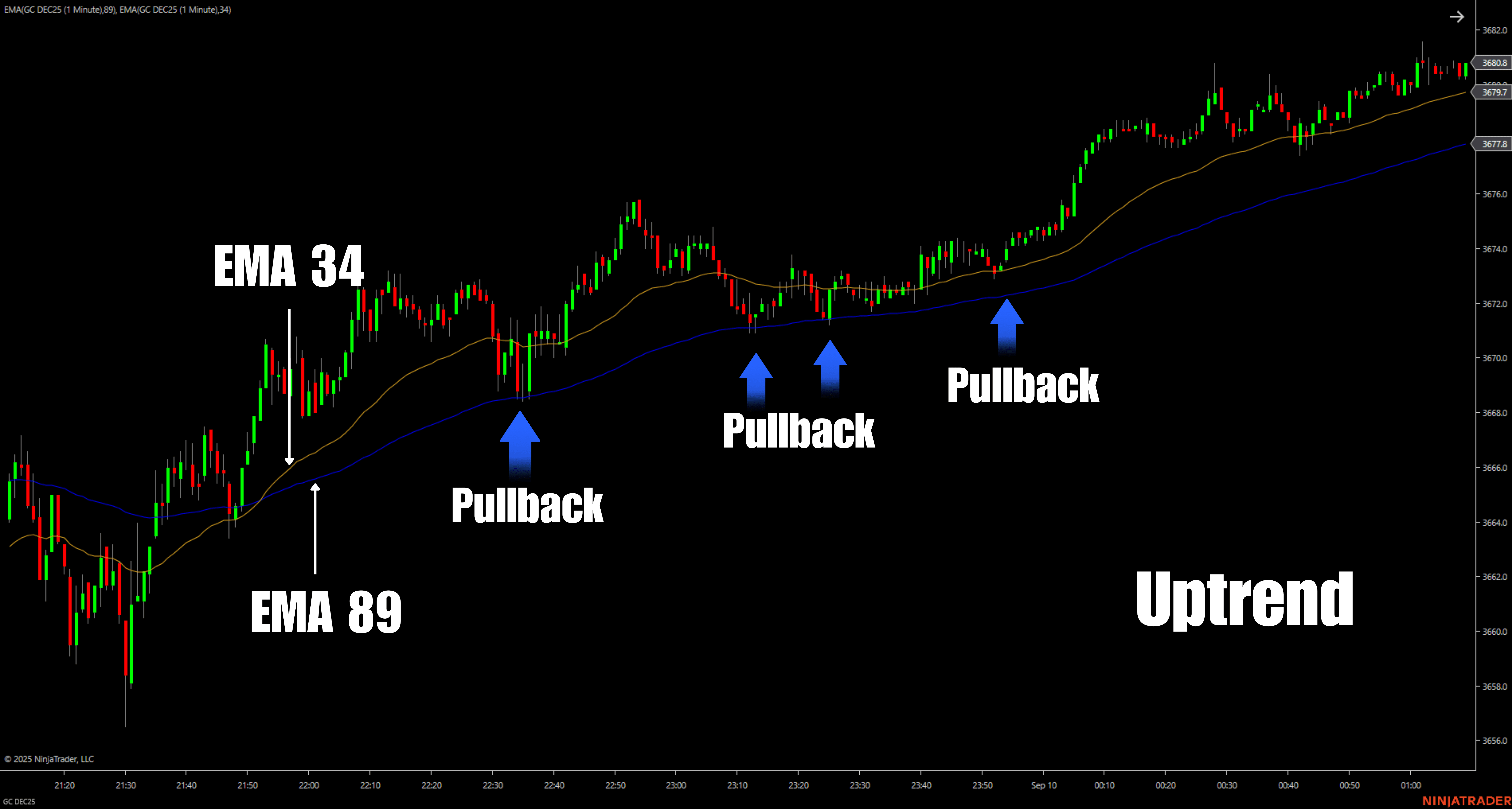
A pullback is one of the simplest and most reliable futures trading strategies for beginners. Instead of chasing the market when it’s already moving fast, you wait for price to “pull back” to a key level before entering in the direction of the trend.
How it works:
- In an uptrend, price breaks above resistance (for example, on the E-mini S&P 500 at the CME) and then temporarily falls back toward that level. The old resistance becomes new support. Traders buy the dip, aiming for the trend to continue upward.
- In a downtrend, price dips below support (like Micro NASDAQ futures) and then retraces upward toward the broken level. The old support becomes new resistance. Traders enter short, expecting the decline to resume.
Why it works well:
- Provides clear entry and exit points (buy at support, sell at resistance).
- Risk can be defined easily by placing a stop-loss just beyond the pullback level.
- Works on multiple timeframes – from 5-minute day trading setups to swing trades on daily charts.
Common mistake to avoid:
New traders often jump in too early or mistake a full reversal for a pullback. Waiting for confirmation – such as a bullish candlestick in an uptrend – helps filter false signals. Overtrading every retracement is another pitfall, often fueled by fear of missing out (FOMO).
2. Breakout Trading: Riding the start of a strong move
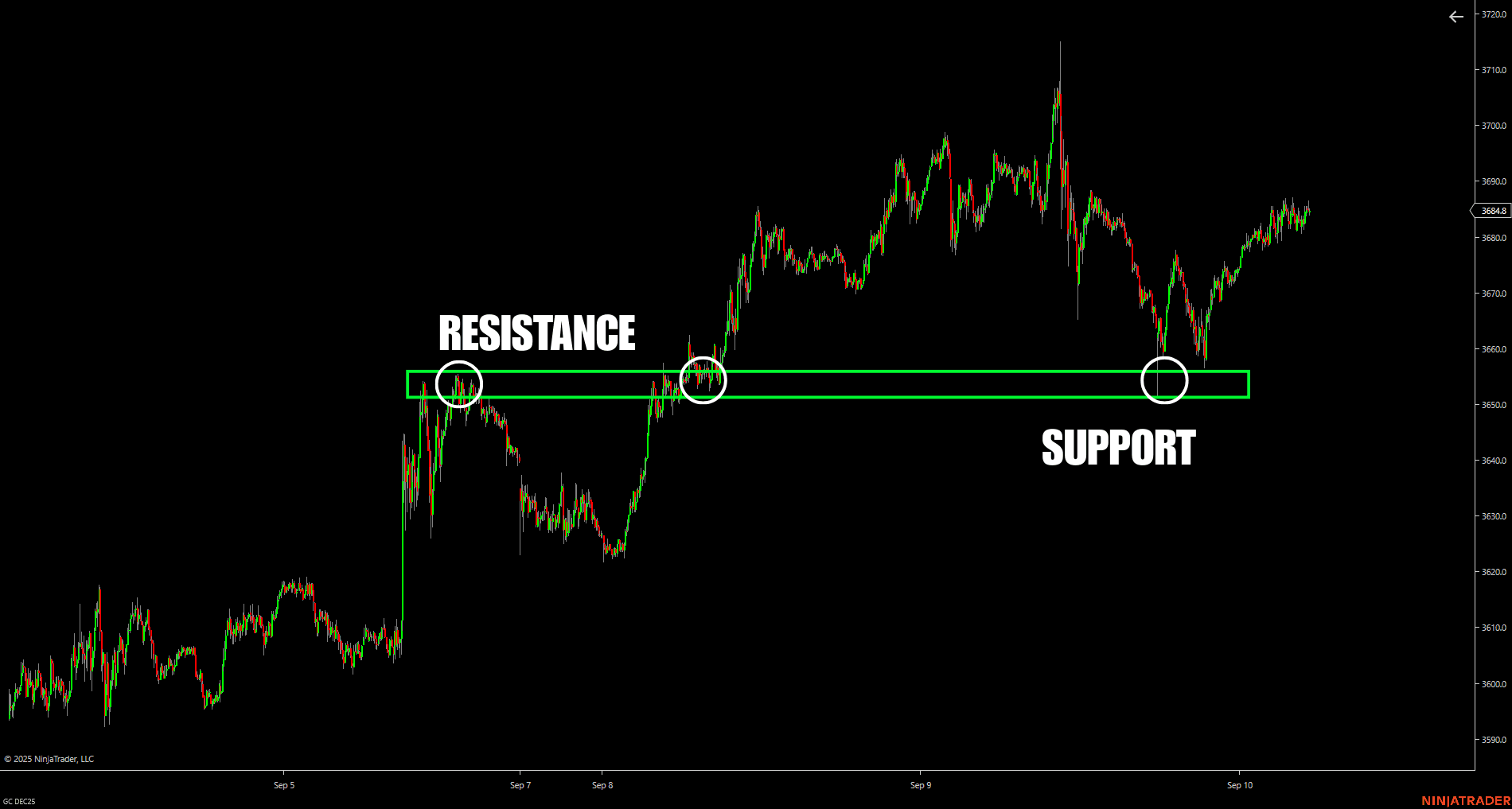
A breakout occurs when price moves decisively beyond a key support or resistance level, signaling the potential start of a new trend. Breakouts are popular among beginners because they offer clear entry signals without waiting for the market to “prove itself” through a long trend.
How it works:
- Identify a tight trading range or consolidation on instruments like E-mini S&P 500 (ES), Micro NASDAQ (MNQ), or Crude Oil futures (CL).
- Place pending orders just beyond resistance for long entries or just below support for short entries.
- When price breaks the level with increased volume, the trade is triggered. For example, ES trading between 4500–4520; a buy-stop above 4520 triggers the long entry.
Why it works well:
- Entry rules are clear – buy above resistance, sell below support.
- Stop-loss can be placed just inside the previous range, keeping risk defined.
- Works across multiple timeframes – from 5-minute day trading setups to daily swing trades.
Common mistakes to avoid:
- Entering too early before the breakout is confirmed by volume.
- Ignoring false breakouts during low liquidity periods (e.g., overnight sessions).
- Overtrading minor range breaches instead of waiting for a decisive move.
3. Range Trading: Capturing profits in sideways markets
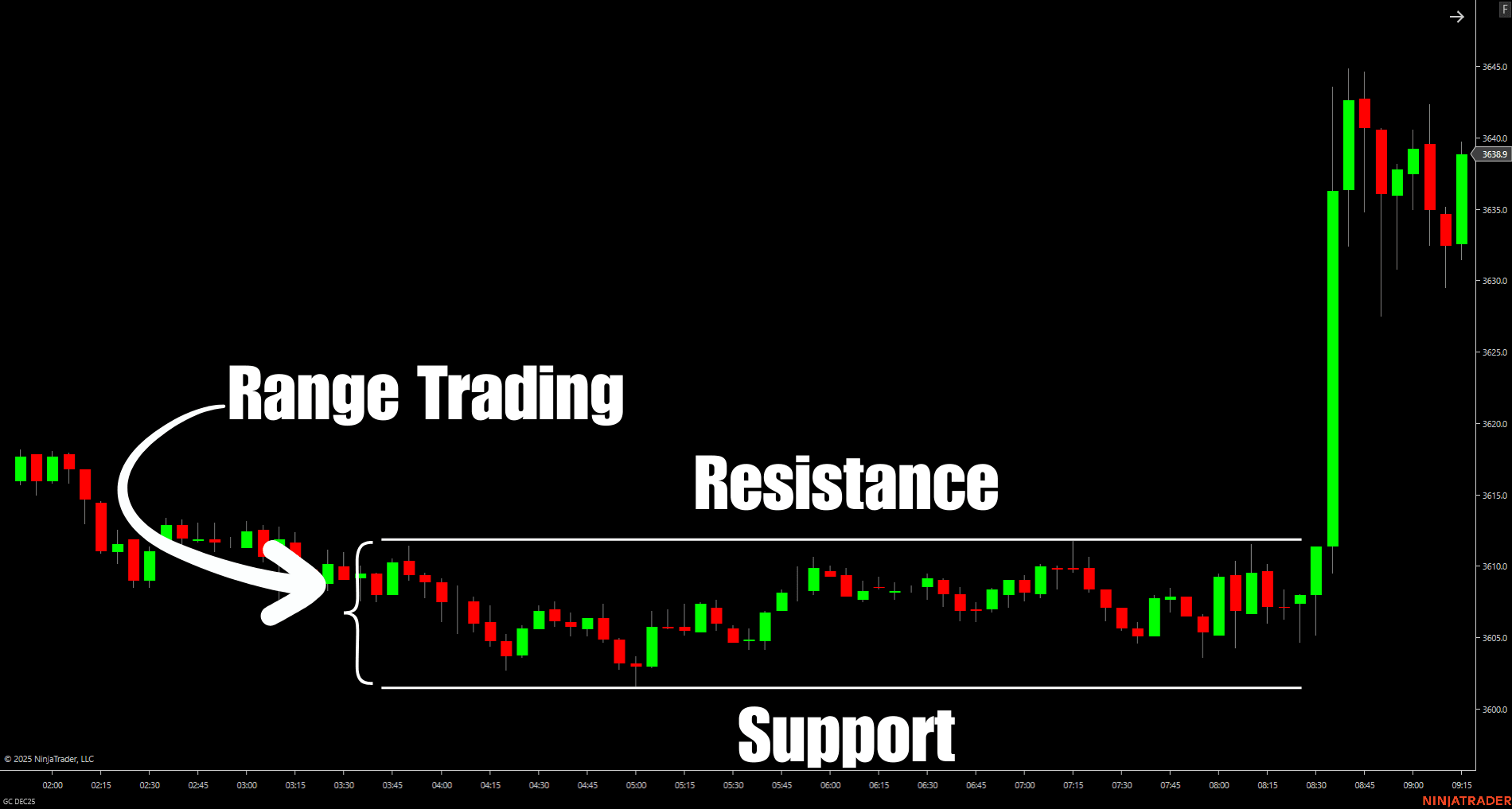
Range trading is one of the most beginner-friendly futures trading strategies. Instead of trying to predict a big trend, you focus on price oscillations between well-defined support and resistance levels. This approach allows traders to enter and exit with clarity while minimizing exposure during sideways markets.
How it works:
- Identify a trading range where the price repeatedly bounces between support and resistance. For example, E-mini S&P 500 futures may oscillate between 4500 and 4520.
- Enter long positions near support and short positions near resistance.
- Place a stop-loss just outside the range to protect against breakout moves that violate the established channel.
Why it works well:
- Clear entry and exit points make it easy to manage trades.
- Low-volatility setup reduces emotional stress and helps practice discipline.
- Works across multiple timeframes – from 5-minute day trading charts to daily swing trades.
Common mistakes to avoid:
- Trading when the market is trending instead of waiting for a clear range.
- Ignoring false breakouts at the edges of the range.
- Over-leveraging on small price oscillations.
4. Price Action Trading: Reading the market without indicators
Price Action trading focuses purely on market behavior rather than indicators. Traders analyze candlestick patterns, support/resistance levels, and trend structure to make decisions, making it one of the most versatile futures trading strategies for beginners.
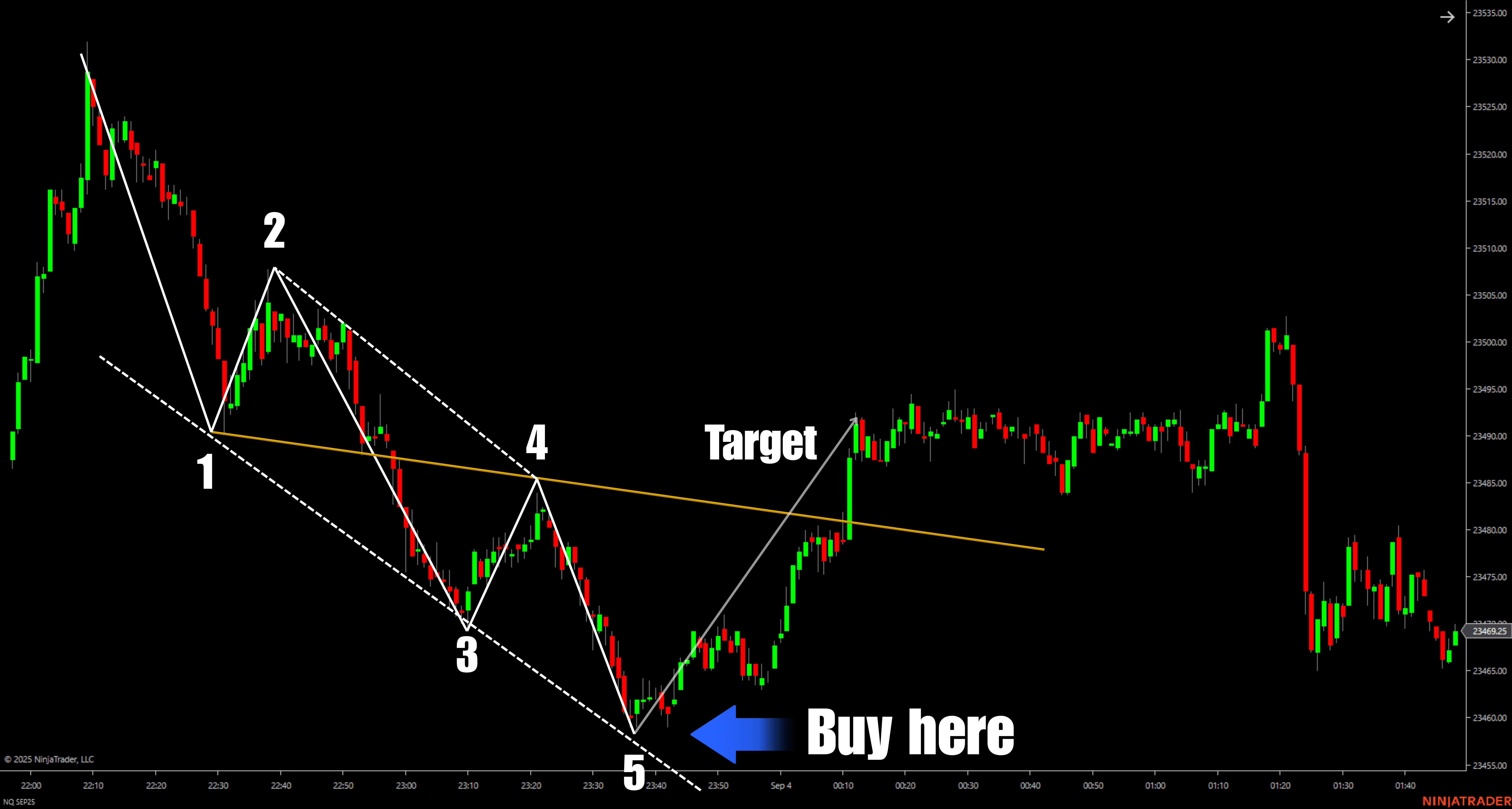
How it works:
- Watch how price reacts at key levels: previous day highs/lows, pivot points, or major support/resistance zones.
- Identify candlestick patterns like pin bars, engulfing bars, or inside bars for entries.
- Confirm moves with volume spikes or order flow to ensure there’s real buying or selling pressure.
Why it works well:
- No reliance on complex indicators – purely visual and intuitive.
- Helps develop market reading skills that are essential for all futures trading strategies.
- Adaptable across multiple timeframes and assets, from E-mini S&P to crude oil futures.
Common mistakes to avoid:
- Jumping in without waiting for confirmation signals.
- Ignoring broader trend context or market structure.
- Overtrading small fluctuations without clear setup.
Advanced Futures Trading Strategies 2026
Once you’ve mastered the basics of futures trading strategies, some traders look for more advanced approaches to gain a competitive edge. These strategies go beyond simple pullbacks or breakout setups and focus on market structure, liquidity, and sophisticated risk management.
Advanced methods are particularly useful for day trading, swing trading, or trading higher-value contracts like E-mini S&P, Micro NASDAQ, or crude oil futures. They often combine technical analysis with real-time market data, such as order flow or volume profile, and may involve hedging, spreads, or algorithmic approaches.
1. Order Flow & Volume Profile: Seeing market activity beneath the surface
For experienced traders, understanding order flow and volume profile can provide a significant edge. Unlike simple trend-following or price action strategies, these techniques give insight into market participants’ behavior, allowing you to anticipate potential reversals, breakouts, and liquidity zones.
How it works:
- Order flow tracks actual buying and selling at each price level through footprint charts or DOM (Depth of Market). You can see where large institutional orders are entering or exiting.
- Volume profile maps trading volume at each price over a given period, highlighting high volume nodes (HVNs) as support/resistance and low volume nodes (LVNs) as potential breakout zones.
- Combine both tools to identify where the market is absorbing or rejecting liquidity, helping to refine entry, stop-loss, and take-profit levels.
Why it works well:
- Provides real-time insight into market activity rather than lagging indicators.
- Helps anticipate short-term reversals, breakouts, and exhaustion points.
- Can be applied across all futures contracts (E-mini S&P, Micro NASDAQ, Crude oil) and timeframes.
Common mistakes to avoid:
- Relying solely on order flow without context – volume spikes can be misleading during news events.
- Ignoring overall trend or market structure when reading profiles.
- Overtrading small fluctuations without clear liquidity confirmation.
2. Hedging & Spread Trading: Managing risk beyond directional bets
For experienced futures traders, managing risk is just as important as seeking profits. Hedging and spread trading are advanced techniques that help protect capital, reduce volatility exposure, and exploit relative price movements between contracts.
- Hedging involves taking a position in a futures contract to offset potential losses in the underlying asset. For example, a corn or wheat farmer might sell grain futures to lock in prices before harvest, while an airline may buy crude oil futures to stabilize jet-fuel costs against rising energy prices. Both cases use futures to manage risk rather than to speculate.
- Spread trading focuses on the price difference between two related contracts instead of outright price direction. Common approaches include:
- Calendar spreads: Trading the same commodity with different expiration months (e.g., Crude Oil December vs. March contracts) to profit from seasonal shifts or storage costs.
- Inter-commodity spreads: Trading 2 correlated markets (e.g., Crude Oil vs. Heating Oil) to capture changes in their price relationship.
Why it works well:
- Reduces exposure to unexpected market volatility.
- Allows traders to take advantage of relative price moves even when overall markets are flat.
- Provides a structured way to balance risk and return, especially for swing and day trading.
Common mistakes to avoid:
- Over-hedging and reducing potential profits.
- Ignoring transaction costs, which can eat into spread trading returns.
- Confusing correlation with causation – just because two contracts move together historically doesn’t mean they always will.
3. Algo & Indicator Strategies: Systematic approaches to Futures Trading
Algorithmic and indicator-based strategies are popular among experienced futures traders because they automate decision-making, reduce emotional bias, and enable trading at high speed or across multiple contracts. These approaches rely on mathematical models, technical indicators, and predefined rules to enter and exit trades.
How it works:
- Algorithmic trading uses code to execute trades based on predefined conditions. For example, a program might automatically buy Micro NASDAQ futures when a moving average crossover occurs with volume confirmation.
- Indicator-based strategies combine tools like RSI, Bollinger Bands, MACD, or custom order flow indicators to detect market trends, overbought/oversold conditions, or breakout points.
- Traders can backtest strategies on historical data to optimize parameters and verify performance without risking real capital.
Why it works well:
- Eliminates emotional decisions such as overtrading or revenge trading.
- Can execute high-frequency or multi-contract strategies that are impossible manually.
- Provides consistency in execution while allowing customization for different trading styles (scalping, day trading, swing trading).
Common mistakes to avoid:
- Blindly trusting an algorithm without understanding its logic.
- Overfitting the model to historical data, leading to poor live performance.
- Ignoring changing market conditions that may require adjustments to indicators or rules.
Choosing the right trading strategy for your style
Selecting the right futures trading strategy depends on your trading style, time commitment, and the markets you focus on. A strategy that works for a day trader on E-mini S&P 500 may not suit a swing trader holding Micro NASDAQ or Crude Oil futures for several days.
Factors to consider:
Factor | Details | Tips |
| Trading style | Day trading, swing trading, scalping | Start with shorter timeframes for day trading; use pullbacks or breakouts for swing trades |
| Market & Contract type | Indices, commodities, energy, metals | Micro contracts are ideal for beginners due to lower capital requirements |
| Time commitment | Hours per day monitoring vs occasional check-ins | Choose strategies that match your availability; range trading or swing setups for part-time traders |
| Risk appetite | Conservative, moderate, aggressive | Pullbacks and range trading often carry lower risk than breakout or algo strategies |
| Tools available | Charting, volume profile, order flow | Ensure you understand and can implement the tools required for the chosen strategy |
How to choose your trading strategy:
- Assess your schedule and attention span. Day traders need strategies that offer multiple signals daily, whereas swing traders focus on fewer but larger moves.
- Start simple and build complexity. Beginners can begin with pullbacks, breakouts, and range trading, then layer in Wolfe Wave or price action techniques as confidence grows.
- Align with your risk tolerance. For volatile contracts like crude oil, conservative strategies with defined stop-losses reduce emotional trading.
- Test with a demo account or micro contracts. This provides hands-on experience without risking significant capital.
Your comfort level with a strategy is just as important as its technical merits. If you find yourself overtrading, fearing missing out, or second-guessing signals, the strategy may not match your style.
Use a combination of your preferred timeframe, risk tolerance, and contract type to create a personalized trading plan. Even experienced traders adjust their strategy when switching markets or adapting to changing volatility.
Risk management essentials in Futures
Risk management is the backbone of any successful futures trading strategy. Without it, even technically perfect trades can wipe out your account in volatile markets like E-mini S&P 500, Micro NASDAQ, or Crude Oil futures.
Key principles:
- Define Risk per Trade
- Decide in advance how much of your account you’re willing to risk on a single trade. Many professional traders risk 1–2% of their account per trade.
- Use stop-loss orders at logical support/resistance levels to enforce discipline.
- Position sizing
- Adjust the number of contracts according to your risk tolerance and volatility of the instrument.
- Example: If crude oil futures are more volatile, reduce contract size or widen your stop-loss proportionally.
- Leverage management
- Futures are highly leveraged. Don’t maximize margin just because it’s available; over-leveraging is a common cause of rapid account drawdowns.
Always calculate risk-adjusted leverage before entering a trade.
- Futures are highly leveraged. Don’t maximize margin just because it’s available; over-leveraging is a common cause of rapid account drawdowns.
- Diversification across instruments
- Avoid putting all your risk on a single contract. Spread exposure across indices, commodities, or energy products to reduce systemic risk.
- Trade planning & psychology
- Define your entry, exit, and contingency plans before placing a trade.
- Stick to your plan to minimize the impact of emotions like fear and greed, which often lead to overtrading or revenge trading.
- Continuous review & adaptation
- Keep a trading journal. Document entry price, stop-loss, target, outcome, and psychological state.
- Review periodically to identify patterns of mistakes and adjust strategy accordingly.
Even if your futures trading strategy is technically sound, poor risk management can turn profitable setups into losses. Combine defined stops, position sizing, and disciplined planning to survive and thrive in volatile markets.
Checklist before entering a Futures trade
Before you commit capital to any futures contract, having a clear pre-trade checklist can make the difference between consistent results and impulsive mistakes. A structured approach ensures you address risk, timing, and market conditions, helping you trade more systematically and with confidence.
- Define your trade objective
- Are you aiming for a short-term scalp, swing trade, or longer-term position?
- What profit target fits your plan?
- Example: Targeting 10 points on E-mini S&P 500 pullback vs. 50 points on a swing trade.
- Confirm trend and market conditions
- Identify the dominant trend using moving averages, trendlines, or price action.
- Check for volatility spikes or consolidations that could affect your entry.
- Entry Rules
- Know your exact entry point and conditions.
- Use confirmation signals like candlestick patterns, volume spikes, or support/resistance tests.
- Risk Management & Position Sizing
- Decide how much of your account to risk (e.g., 1–2% per trade).
- Set stop-loss levels based on technical levels, not emotions.
- Example: Place stop 2–3 ticks beyond support in Micro NASDAQ futures.
- Tools & Indicators Check
- Ensure charting tools and indicators are properly set up (trend indicators, volume profile, DOM, Fibonacci levels).
- Psychology & Discipline
- Assess emotional readiness – are you focused, calm, and following your plan?
- Avoid revenge trading or chasing losses.
- Review & Document
- Review past trades or similar setups.
- Keep a trading journal to capture lessons and improve strategy over time.
Following this checklist ensures that you enter futures trades with structure and confidence, reducing impulsive decisions that can quickly erode capital.
Trusted indicators for futures trading strategies (NinjaTrader 8)
Building a solid futures trading strategy often comes down to pairing the right setup with the right indicator. Even a well-designed strategy – whether it’s trend following, breakout, or reversal – can perform more consistently when supported by tools that clarify market direction and highlight opportunities.
In our 2026 collection for NinjaTrader 8, you’ll find indicators grouped by their strengths, making it easier to see how each one can support both beginner and advanced futures trading strategies.
Essential indicators to enhance your Futures trading
Here’s a detailed look at some indicators and systems:
- Easy Trend
As a moving average–based indicator, Easy Trend helps traders stay aligned with the dominant market direction. It makes trend interpretation visual and straightforward, highlighting when the market is trending up, down, or flat.
With 11 moving average types and 11 smoothing methods, plus an angle filter to reduce noise, it offers plenty of flexibility for different trading styles.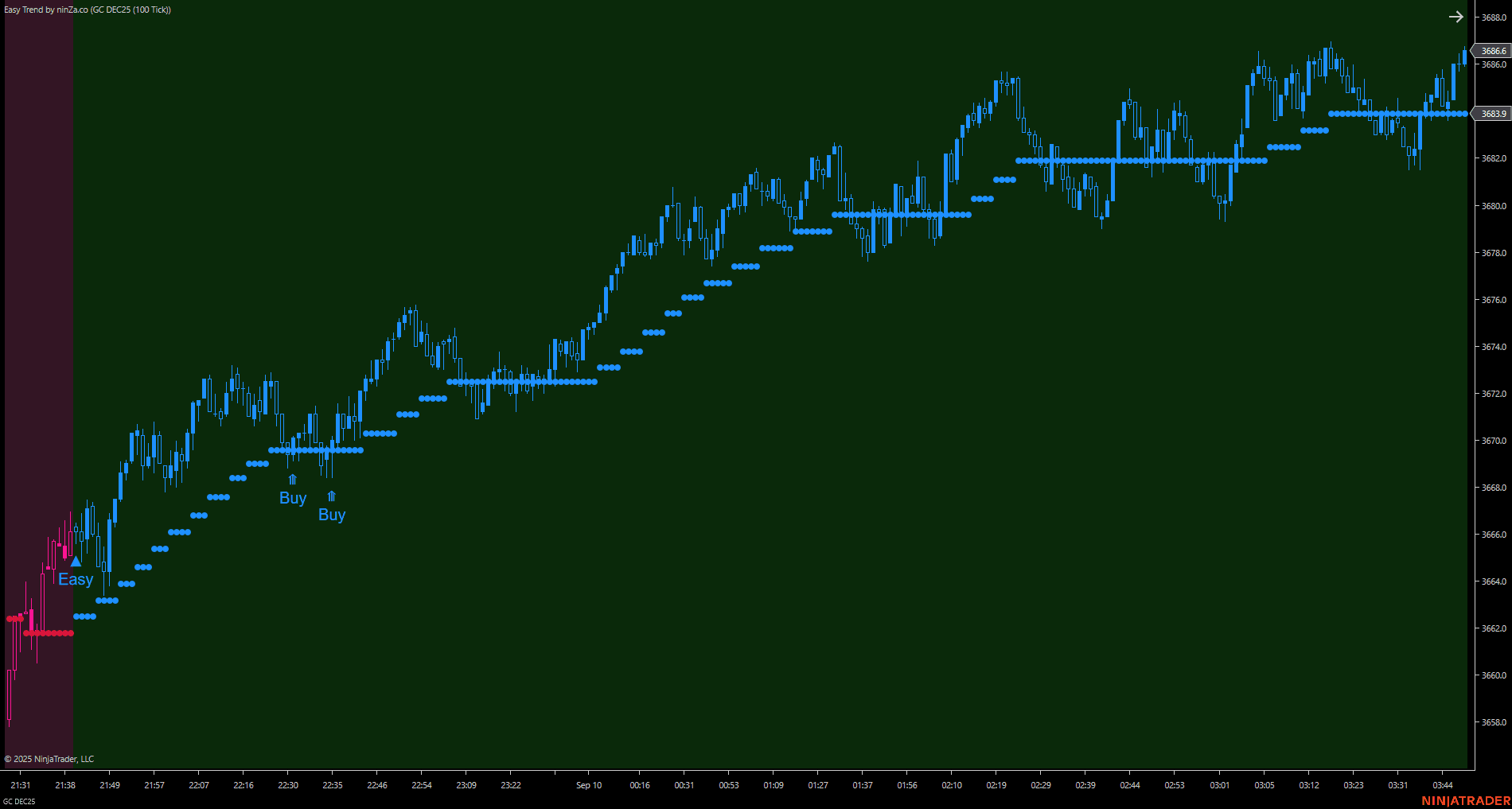
Best suited for:- Pullback trading strategy: Confirm the main trend before entering on retracements.
- Breakout trading strategy: Filter breakouts to trade only in the direction of trend.
- Algo & indicator-based strategies: Customizable settings make it ideal for automation.
- Less useful in range trading (indicator stays flat, signaling limited opportunity).
ZoneGPT * From The Future
The ZoneGPT * From The Future system introduces a forward-looking approach to signal generation. It creates Future Signal Zones ahead of price movement, guided by the Center Torch.
Pullback signals appear when a reversal candle enters the future zone in line with the trend, while reversal signals trigger when candles hit pre-defined zones that extend from past to present price levels.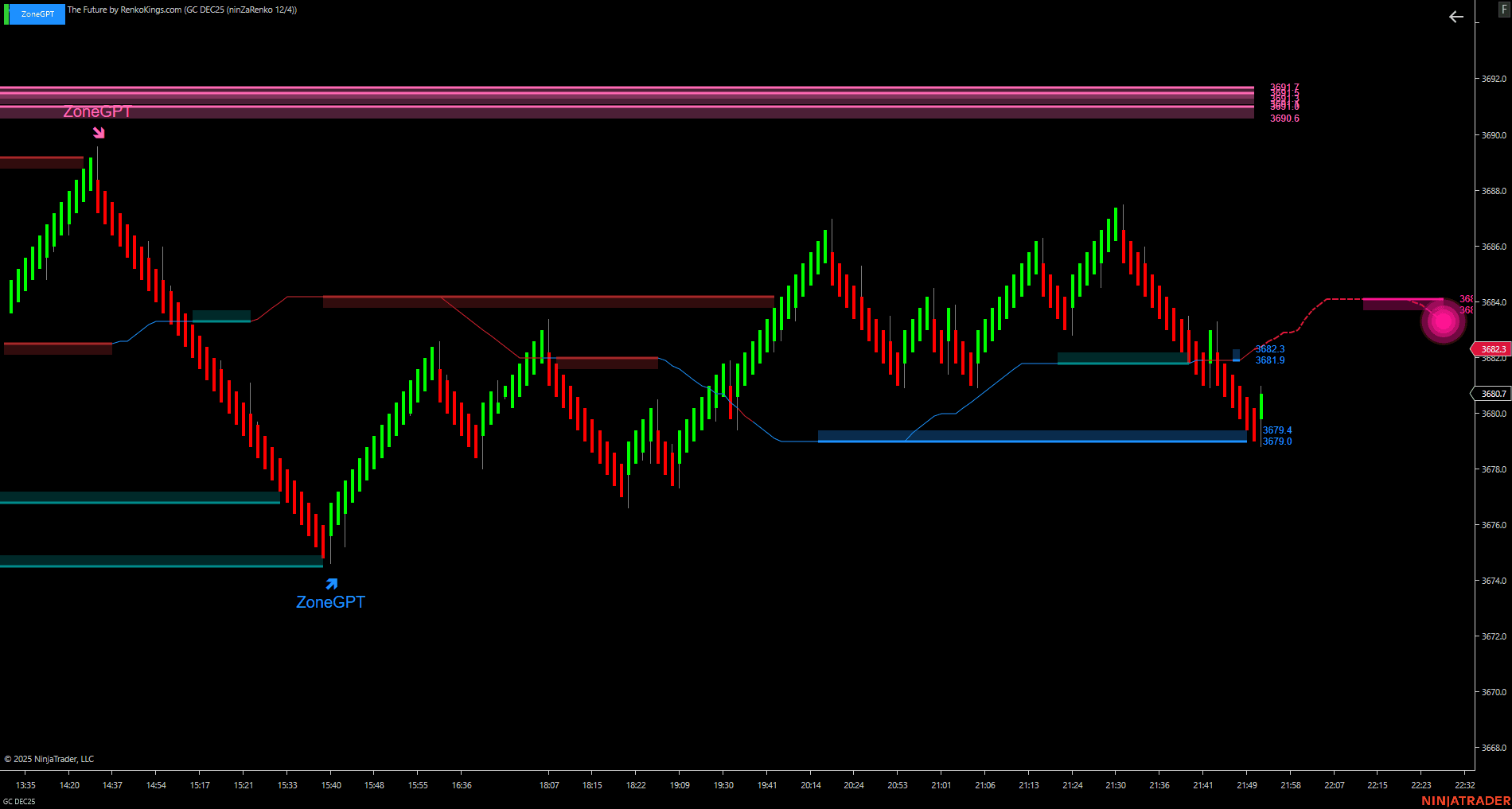
Best suited for:- Pullback trading strategy: Trade trend-aligned pullbacks confirmed by future zones.
- Reversal trading strategy: Capture turning points at pre-defined signal zones.
- Breakout trading strategy: Use future zones as reference levels for breakout validation.
- Range trading strategy: Zones often align with support/resistance boundaries inside consolidations.
With compatibility across all chart types – especially Renko, Tick, Range, and Volume – the system enhances both trend and reversal trading, offering traders a visual and systematic way to anticipate opportunities.
Imbalance Volume Sensor
Imbalance Volume Sensor is built specifically for Renko charts to uncover true market imbalances. Instead of just marking price-based imbalance, it digs deeper into volume, identifying where buying or selling pressure is entirely absent.
You can detect Overall Imbalance Zones (areas of strong buy/sell pressure) and Absolute Imbalance Zones (formed by consecutive ticks with zero activity), giving a sharper picture of order flow dynamics.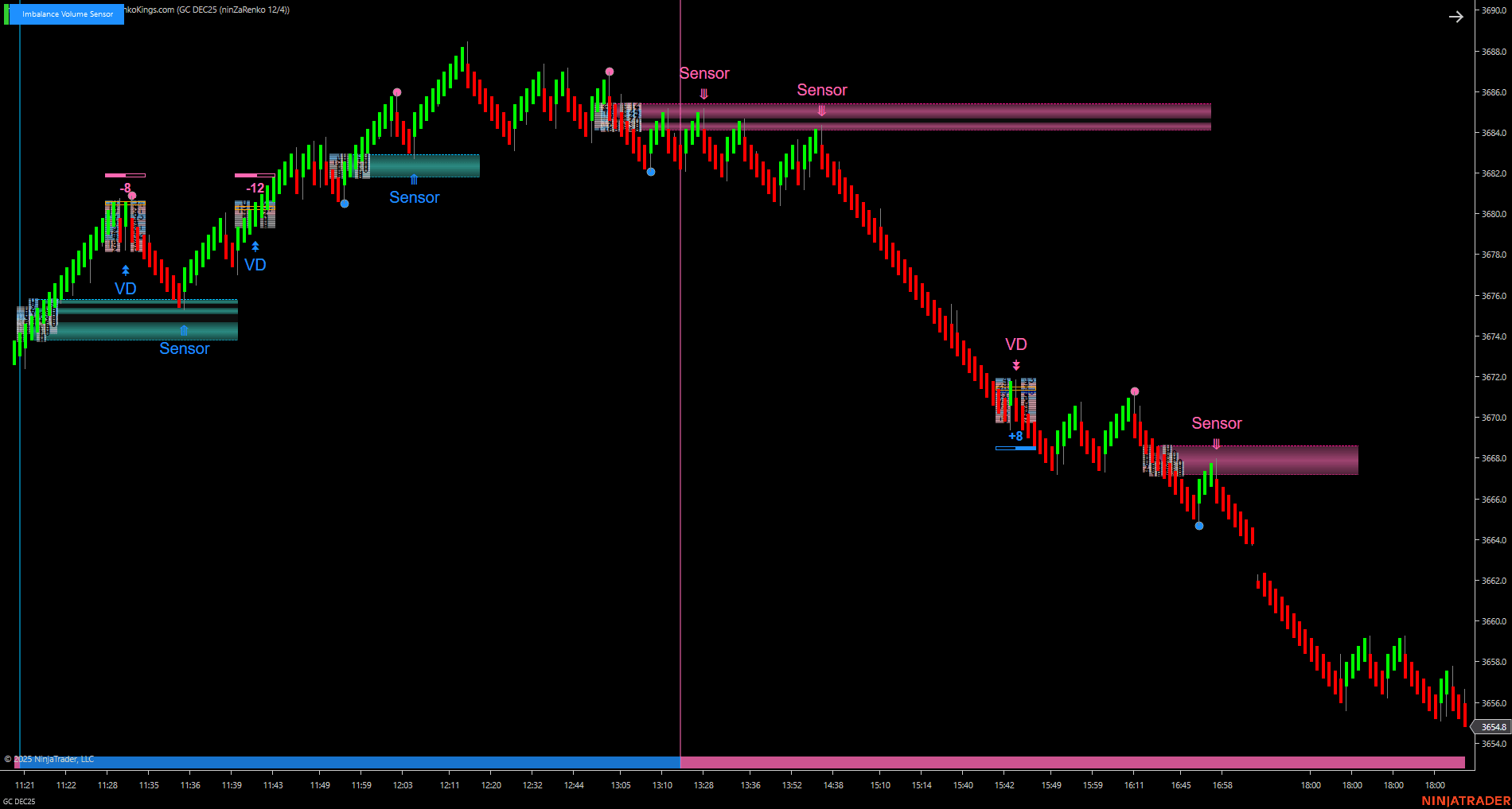
Best suited for:- Reversal trading strategy: Reversals confirmed when price revisits imbalance zones.
- Trend exhaustion detection: Histogram and volume delta highlight weakening trends.
- Volume-based strategies: Track failed buy/sell attempts for early market shifts.
- Position scaling: Absolute Imbalance Zones support contract splitting for consistency.
By combining price action with order flow, this indicator helps traders anticipate turning points, manage larger positions effectively, and read the market with greater precision.
Z-Pattern Triad
Belonging to the Price Action category, Z-Pattern Triad automates candlestick pattern recognition and generates direct buy/sell signals on your chart. It covers three well-known setups: Pin Bar Confirmation for validating reversals, Tweezers Top/Bottom for spotting exhaustion at the end of trends, and Narrow Range for anticipating breakouts after consolidation.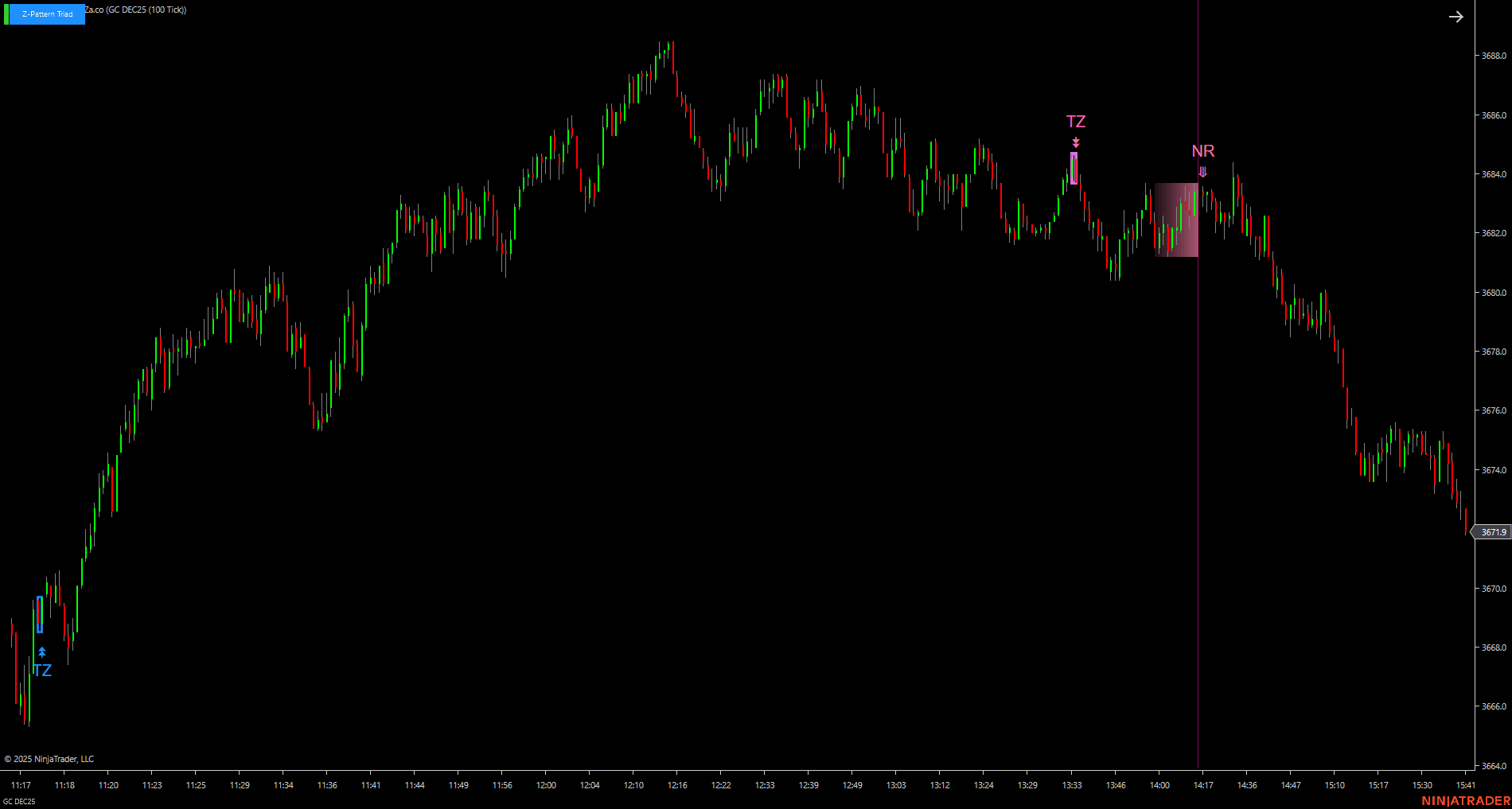
By confirming patterns and instantly marking entries, it saves traders from manual scanning while keeping signals clear and actionable.
Best suited for:- Reversal trading strategy: Pin Bar Confirmation and Tweezers highlight strong turning points.
- Breakout trading strategy: Narrow Range helps capture momentum after price compression.
- Price action trading: Works seamlessly with traders who rely on candlestick structures and raw chart reading.
- Renko-based setups: Compatible across chart types, including Renko, to enhance pattern clarity.
With its focus on price action and simplicity, Z-Pattern Triad gives traders a structured way to trade classic candlestick signals without the need for manual recognition.
Conclusion
Futures trading strategies give traders more than just entry and exit signals—they provide a framework for consistency, discipline, and risk control in one of the most competitive markets. For beginners, approaches like pullbacks, breakouts, and range trading offer simple ways to build structure and confidence. For experienced traders, advanced methods such as order flow analysis, hedging, and algorithmic systems unlock deeper insights and flexibility.
No single strategy guarantees profits, but combining clear rules, sound risk management, and the right tools helps traders reduce randomness and trade with purpose. The goal is not to find a “perfect” setup but to develop a process you can trust through different market conditions.
As you continue refining your futures trading approach, remember that discipline and adaptability matter as much as technical skill. A well-tested strategy, supported by reliable indicators, can turn the chaos of the futures market into a more systematic and sustainable trading journey.
Futures Trading Strategies: FAQs
1. What are the most common futures trading strategies?
Popular futures trading strategies include trend-following, scalping, spread trading, and hedging. Each strategy focuses on different goals—some aim for short-term profits, while others manage long-term risk.
2. Which futures trading strategy is best for beginners?
Beginners often start with trend-following because it’s easier to identify market direction. More advanced methods like arbitrage or spread trading usually require greater experience and faster execution.
3. How do I choose the right futures trading strategy?
Choosing depends on your risk tolerance, time commitment, and market knowledge. Short-term traders may prefer scalping, while long-term investors often use hedging or position trading.
4. Is futures trading profitable in the long run?
Yes, but profitability depends on discipline, risk management, and consistent strategies. Futures offer leverage, which can amplify both gains and losses, making risk control essential.
5. What is the difference between day trading and swing trading futures?
Day trading closes all positions within the same session, focusing on intraday volatility. Swing trading holds contracts for several days or weeks to capture larger market moves.
6. Can you hedge with futures contracts?
Yes, futures are widely used for hedging price risk. For example, farmers lock in crop prices, and airlines hedge fuel costs using futures contracts.
7. What is spread trading in futures?
Spread trading involves buying one futures contract and selling another related contract. Traders use it to profit from price differences while reducing exposure to overall market direction.
8. How do I manage risk when trading futures?
Effective risk management includes setting stop-loss orders, limiting position size, diversifying contracts, and maintaining proper margin levels.
9. What markets are best for futures trading strategies?
Futures strategies work well in highly liquid markets such as S&P 500, crude oil, gold, and major currencies. Liquidity ensures tighter spreads and smoother execution.
10. Do algorithmic strategies work in futures trading?
Yes, many traders use algorithmic and automated systems to execute futures strategies. These systems help with speed, discipline, and testing strategies across different market conditions.
Download ~ 40 FREE indicators & reach more useful resources !!!
LIVE Intraday Trading | Stop chasing Early Entries. Let Timing guide your entry →

NINZA Indicators
0 online
_1787026707358.svg)
NINZA is an official member of NinjaTrader Ecosystem together with 600+ industry-leading professionals that provide traders with quality trading products & services.




even more payment methods
Quick Links
Instructions
Support
Resources & Information
© Copyright 2026 All Rights Reserved



Because software products may be copied and stored easily, we will NOT issue refunds of any kind. ALL SALES ARE FINAL & NON-REFUNDABLE!
Futures, foreign currency, and options trading contains substantial risk and is not for every investor. An investor could potentially lose all or more than the initial investment. Risk capital is money that can be lost without jeopardizing one's financial security or lifestyle. Only risk capital should be used for trading and only those with sufficient risk capital should consider trading. Past performance is not necessarily indicative of future results.
Hypothetical performance results have many inherent limitations, some of which are described below. No representation is being made that any account will or is likely to achieve profits or losses similar to those shown; in fact, there are frequently sharp differences between hypothetical performance results and the actual results subsequently achieved by any particular trading program. One of the limitations of hypothetical performance results is that they are generally prepared with the benefit of hindsight. In addition, hypothetical trading does not involve financial risk, and no hypothetical trading record can completely account for the impact of financial risk of actual trading. For example, the ability to withstand losses or to adhere to a particular trading program in spite of trading losses are material points which can also adversely affect actual trading results. There are numerous other factors related to the markets in general or to the implementation of any specific trading program which cannot be fully accounted for in the preparation of hypothetical performance results and all which can adversely affect trading results.
NinjaTrader® is a registered trademark of NinjaTrader Group, LLC. No NinjaTrader company has any affiliation with the owner, developer, or provider of the products or services described herein, or any interest, ownership or otherwise, in any such product or service, or endorses, recommends or approves any such product or service.