
_1791967172874.jpg)
NINZA Direct: Ask the Team session (#9)
Explore market waves with Poseidon Trident —E, Wolfe Wave Navigator & Impulse Wave Radar
(1280x720)_1791873759885.jpg)
ZillaTrader Founding Member Lucky Spin
Enter for a chance to win a $50K Boxcar Trading account
_1791367956213.jpg)
FLAMINGO
One trading framework. Two ways to trade.
![[New flagship Renko system] Poseidon Trident —E](https://forestcms.nyc3.digitaloceanspaces.com/media/small_Poseidon Trident —E banner_1789461376412.jpg)
[New flagship Renko system] Poseidon Trident —E
Catch the Sniper Entry. Ride the Strongest Waves.

We hit the limits. So we built ZillaTrader.
A new research & trading platform, built on 12+ years of experience.
Coming November 2026.
[Abs] ATR Ordering
Lock in Risk per trade. No matter the volatility.
The moment your order fills, ATR Ordering reads the market's actual volatility, sets your Stop and Target, and sizes your position – so the trade never risks more than the dollar amount you've set, whether the market is calm or violent, whether you're at the screen or not.
Dynamic contract count sizes automatically to preserve Max Loss
Volatility doesn't wait for anyone to be at the desk
ATR on the same instrument can sit at 8 ticks one day and 18 the next. A fixed Stop – say, always 10 ticks – ends up too tight on a volatile day and too loose on a quiet one.
For a Stop to reflect real volatility, it has to be measured at the exact moment the order fills – not when a pending order is placed, but when price actually reaches it.
Doing this by hand means pulling the ATR at that moment, converting it to tick distance, working out dollar value per tick for the instrument, adding commission, and only then arriving at a contract count that keeps the trade within a set max loss – a chain with several places for error to creep in, especially under the pressure of a live fill.
For a trader who sets a pending order and steps away, that pressure compounds: getting back to the screen at the right second just to start this chain, before the market moves further.
Stay on plan. Even when volatility changes.
A trading plan holds up not because its Stop stays the same in every condition, but because its dollar risk per trade stays the same regardless of the condition.
When the Stop moves with ATR and position size moves opposite it to hold the risk constant, a trader keeps discipline without giving up responsiveness to the market.
ATR Ordering gives traders a faster, more consistent way to carry that trade plan into execution – across both Market Orders and Pending Orders.
Instead of working through each calculation when a setup appears, a trader only needs to define 3 settings in advance:
Parameter 01

how far the Stop should sit relative to market volatility
Parameter 02
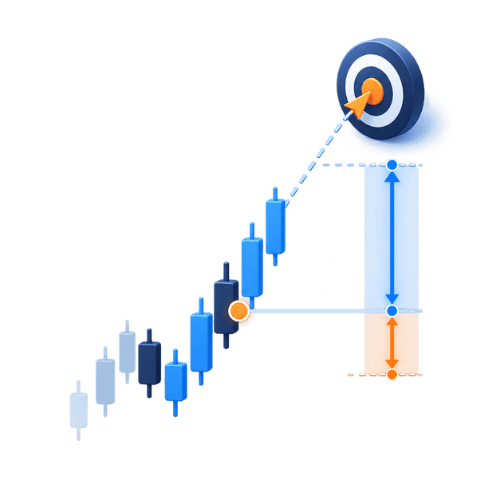
how far the Target should sit relative to the Stop
Parameter 03
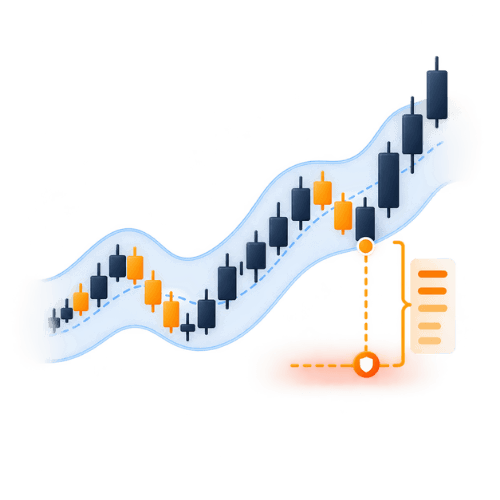
the maximum amount the trade is allowed to risk
From there, the position size adjusts with the Stop and the Target follows the chosen Reward automatically – without that, every shift in volatility means going through the math again, one setting at a time.
A single click on the chart is enough to set the trade in motion. The sizing accounts for commission as well, not just the Stop distance – so when the Stop gets hit, the real loss lands close to the Max Loss set, not beyond it.
One fill. Three decisions handled automatically.
Auto Calculation 01
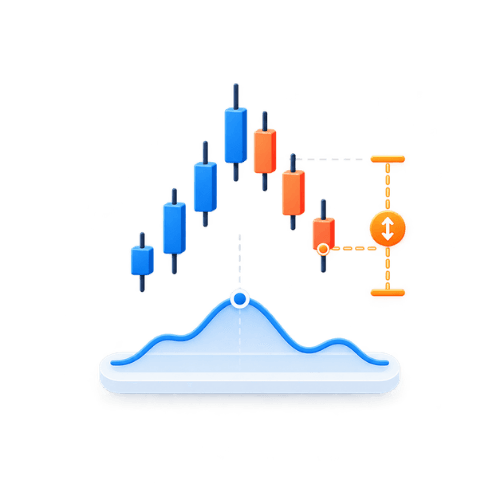
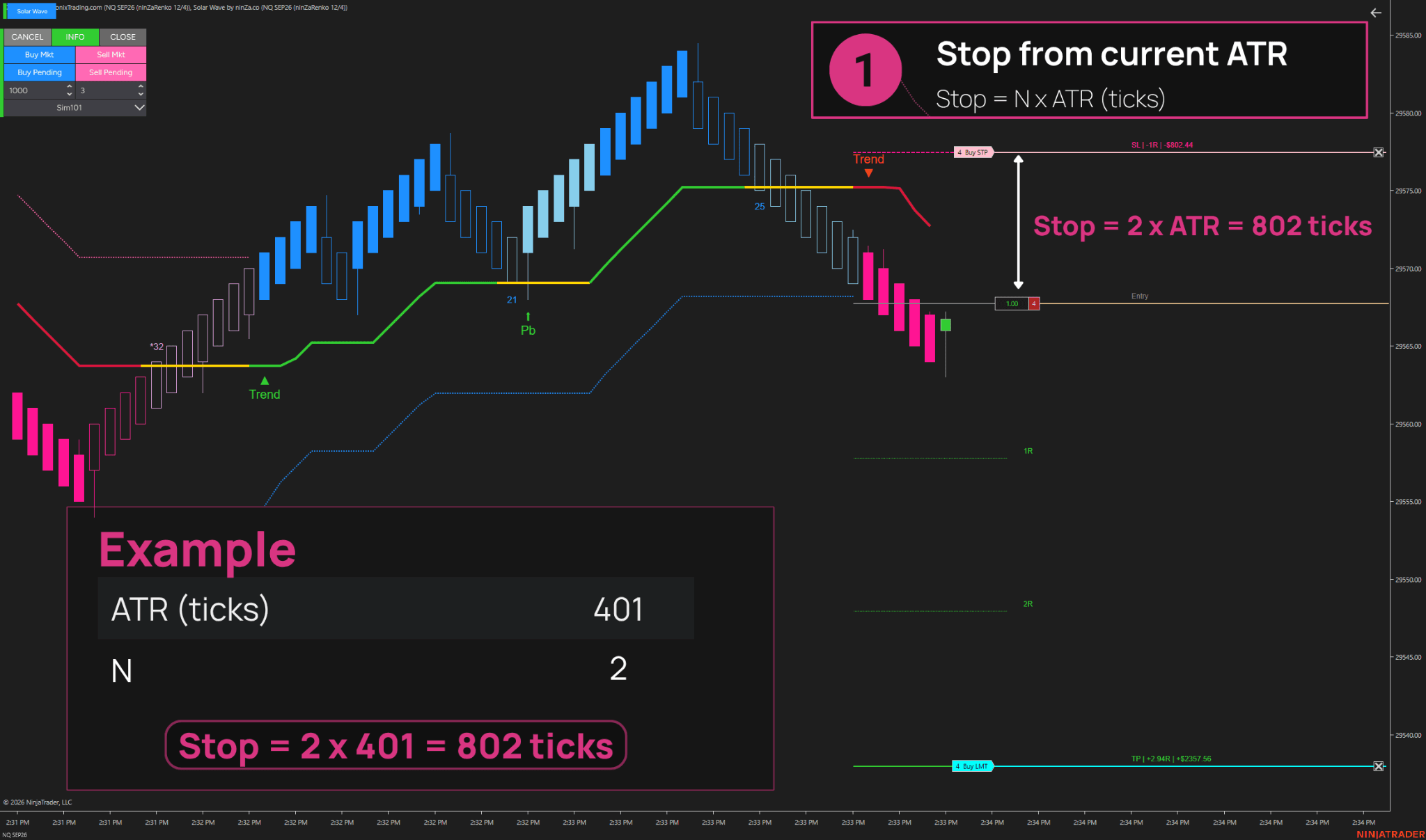
• Stop Distance = N × ATR, with N set by the trader (1.5, 2, or whatever fits their style).
• No need to work out a new distance every time the ATR reading changes.
Auto Calculation 02
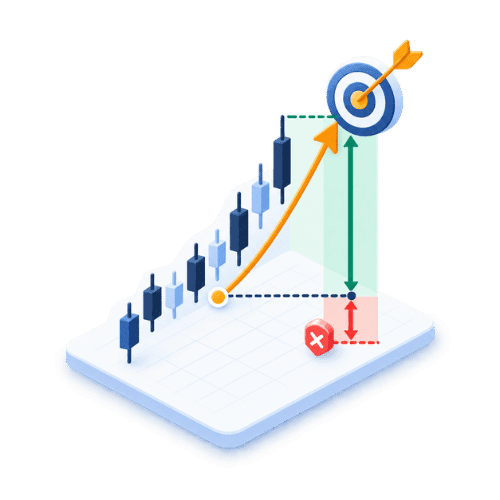
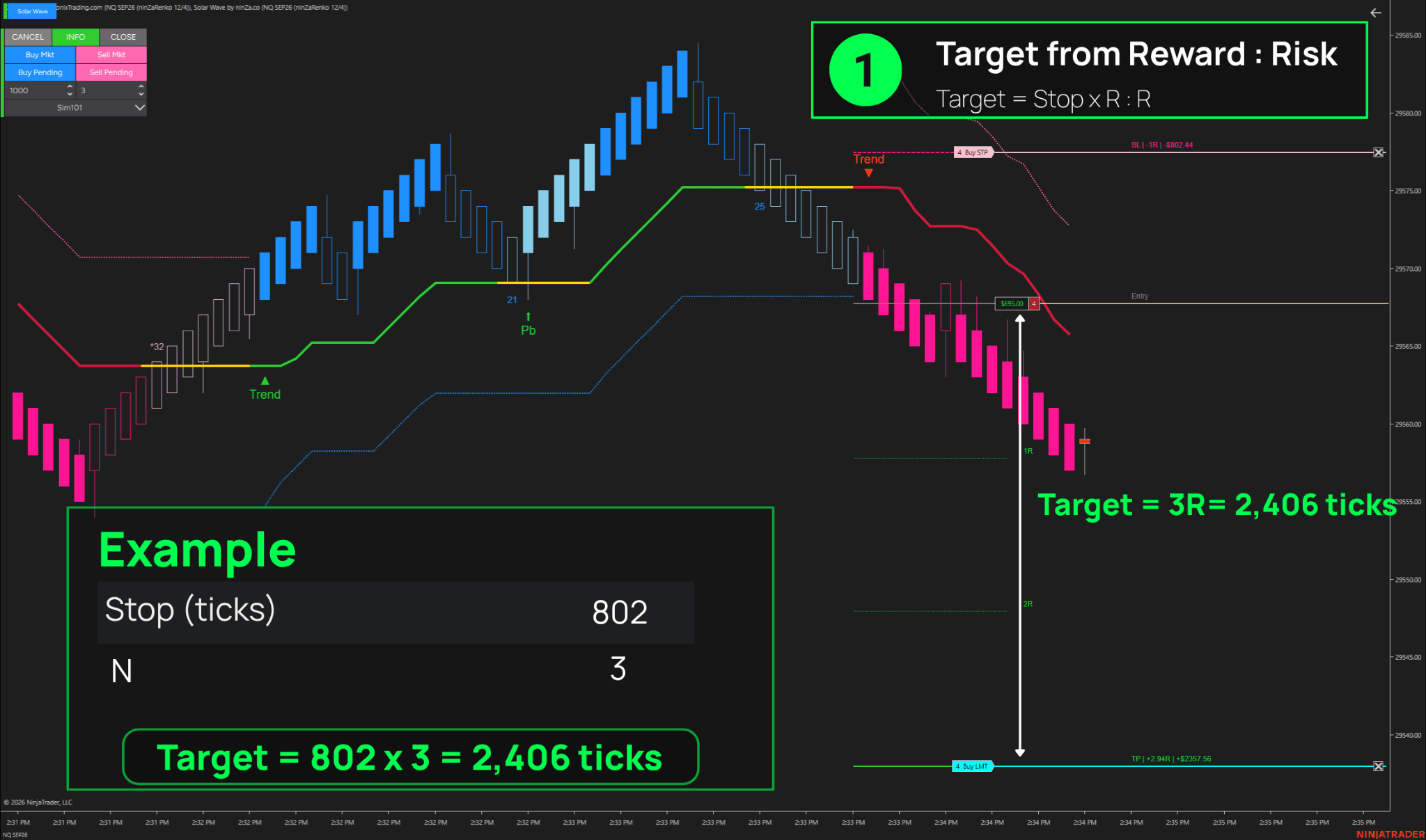
• Target Distance = Stop Distance × R:R.
• The ratio holds no matter how the Stop shifts from one fill to the next.
For example: A 20-tick Stop with a 3 R:R sets a 60-tick Target automatically.
Auto Calculation 03
• Stop distance and commission are converted to dollar terms per contract.
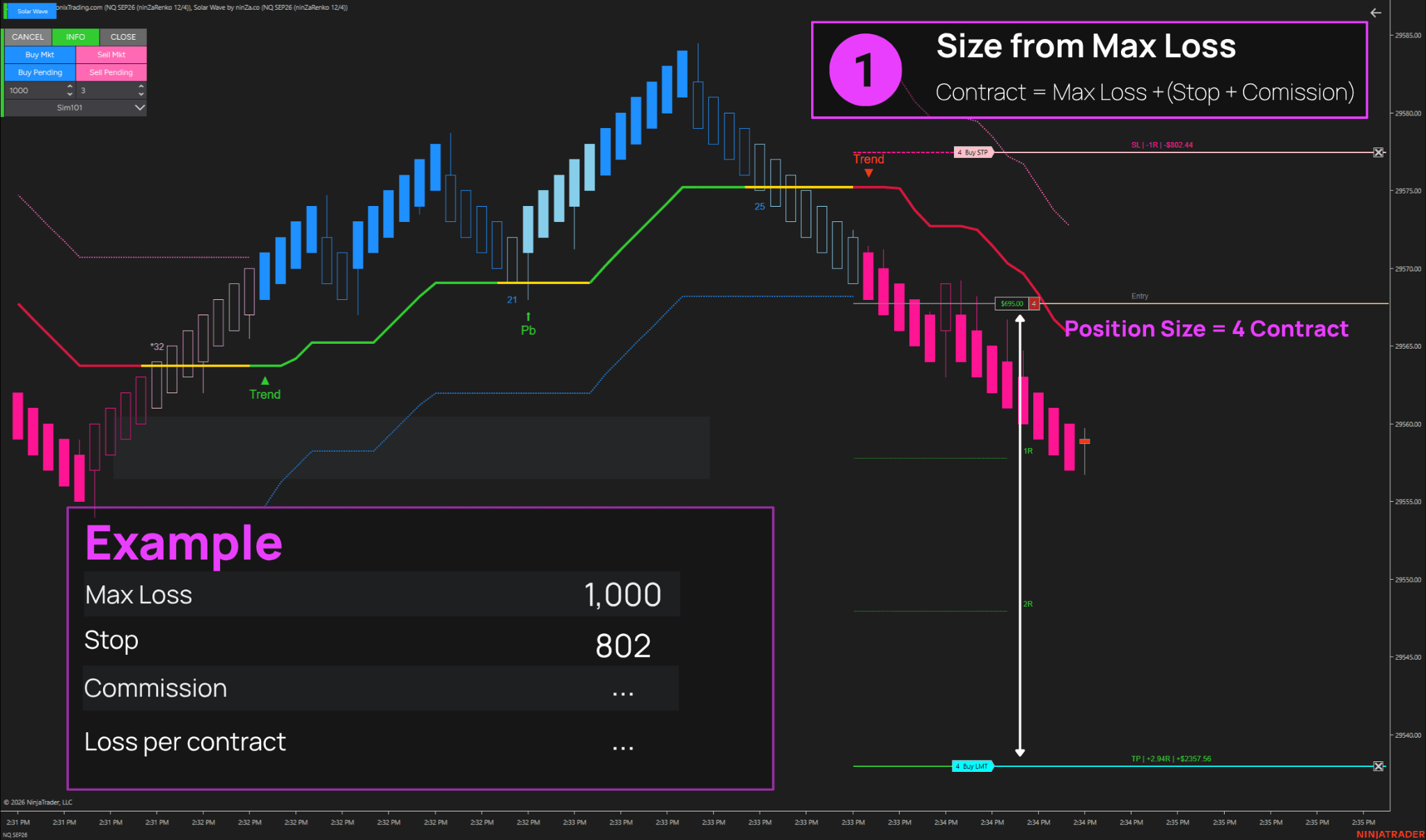
• Then: Contract Count = Max Loss ÷ (Loss per Contract + Commission per Contract)
* rounded down to keep the trade within Max Loss
Instead of pulling tick value and running the multiplication by hand, the count is set automatically.
Entry + Position Size + Stop + Target – all 4 set in milliseconds, no manual math in between.
Put your trading plan on autopilot
Hands-Free
Your trading setup doesn't depend on you being at the screen when price reaches your entry.
A Pending Order can stay in place while you're away.
When it fills, ATR Ordering uses the current ATR to size the position and place the Stop and Target automatically – so you don't have to come back at the exact moment of the fill to complete the trade manually.
This is especially practical for swing and intraday traders who set up trades in advance but can't stay in front of the market all day.
Consistency
Professional traders don't change their risk per trade every time volatility changes. They keep the risk limit fixed and let position size adapt around it.
A lower ATR means a tighter Stop, so more contracts can be taken within the same risk limit.
A higher ATR means a wider Stop, so fewer contracts are used.
ATR Ordering automatically adjusts the position size to match the Stop distance, so the trade stays within the Max Loss defined in your plan – even as volatility changes from one trade to the next.
That means you can eliminate the tedious manual calculations behind every trade – from ATR and Stop distance to tick value, contract size, and commission.
Execution Control
ATR Ordering builds the R:R ratio into the order itself, so your planned Reward is applied consistently from trade to trade.
If your Trading Plan calls for a 1:3 Reward, the tool automatically sets the Target at 3R based on the actual Stop distance.
Without ATR Ordering, you keep having to double-check your R:R ratio on every trade, adding another repetitive step to live execution. And when that check gets skipped, a trade can end up with a different R:R than the one defined in your Trading Plan.
Live execution in action
Across both ATR Ordering live trading sessions, every trade entry, Stop Loss, and Take Profit follows the tools and checklist shown on the chart – from setup to exit in real market conditions.
In this video, James Buchman demonstrates live trading on MNQ using ATR Ordering, together with RK-Sys Platinum v4 and SMMA Pro as a trend filter. He walks through several real trade setups, showing how position size, targets, and stops change as market volatility shifts, with multiple trades reaching their targets during the session.
This session applies the same checklist across 19 trades, including retests, breakouts, reversals, and range conditions. Only 2 trades end in a loss, with ATR Ordering handling Stops and Targets at a 1:1 reward-to-risk ratio.
This session covers bullish, bearish, and sideways conditions, with the approach adapting as market structure changes. It finishes with 15 trades and only 1 loss.
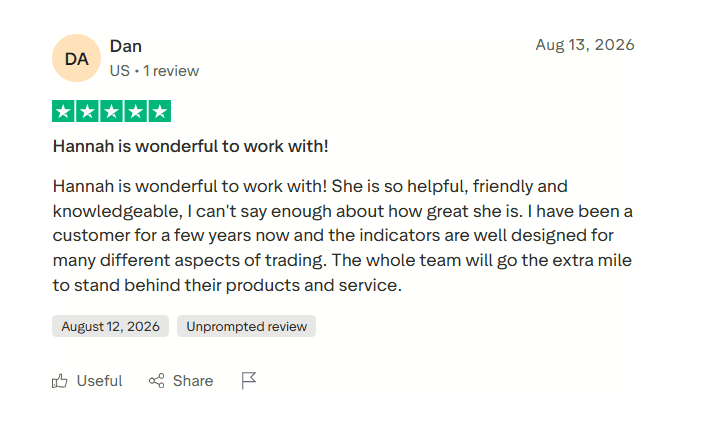
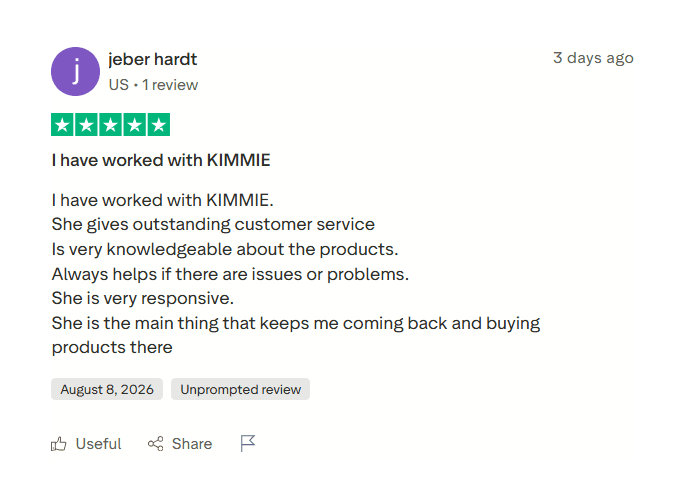
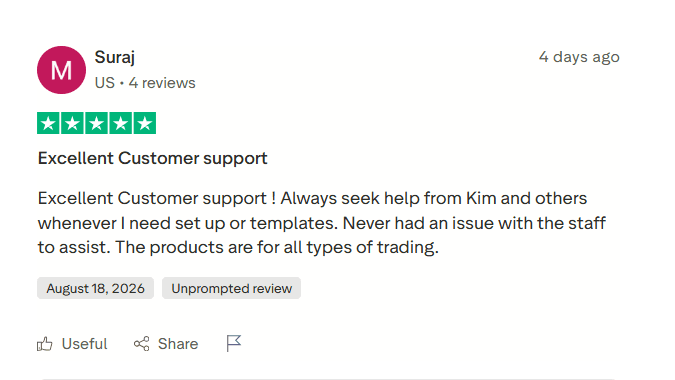
Hear what traders say about their experience with our products and support.




The questions traders usually ask
Why automate the calculations I can already do myself?
You can. The question isn’t whether you can do the math – it’s whether you want to repeat it accurately, consistently, and at the exact moment each trade fills.
Each trade requires you to check the current ATR, calculate the Stop distance, convert it to ticks, determine the risk per contract, account for commission, calculate the contract size, and then set the Target according to your R.
ATR Ordering automates the calculations behind each trade. Set your ATR Multiplier, Reward, and Max Loss per Trade once, and it handles the rest automatically when your order fills.
To make trying it easier, you’re covered by our 30-day exchange guarantee if ATR Ordering does not suit your trading needs.
I use a fixed Stop. Isn’t that enough?
A fixed Stop can work well when it fits your trading plan. The issue is that the same Stop distance does not always fit the market.
A fixed Stop keeps the price distance the same – not the Stop’s relationship to current volatility.
A 10-tick Stop is relatively wide when ATR is 6 ticks, but much tighter when ATR is 18 ticks. The market changes, while the Stop stays the same.
ATR Ordering takes the opposite approach: the Stop adapts to volatility, while Position Size adjusts to keep Dollar Risk within your limit.
The ordering tool comes with a step-by-step video guide to help you get started and make the most of the tool. And if you need any help along the way, our team is always ready to assist via email or remote session whenever needed.
I only trade 1–2 contracts. Do I really need Position Sizing?
Position Sizing isn’t only for traders using large position sizes.
Even with Micro Futures, a 10-tick Stop and a 25-tick Stop create very different Dollar Risk per Contract.
If you always trade 2 Contracts regardless of how wide the Stop is, what stays fixed is your Contract Count – not your Risk.
ATR Ordering reverses that logic: Fixed Risk → Stop adapts to volatility → Contract Count adapts to the Stop.
That’s how you keep your Risk Budget consistent from one trade to the next.
Getting ATR Ordering up and running doesn’t have to be complicated. Our team is available to assist with installation and setup via email or remote session whenever needed.
What if I want to take profit at different Targets?
ATR Ordering is designed to standardize Risk at Entry – not dictate how you manage the trade afterward.
The initial Stop and Target give the entire position a common Risk Model:
Current ATR → Stop Distance → Max Loss → Position Size → Target based on R
After Entry, you can still manage the position your way – including Scale Out, Trailing Stop, or multiple Targets, as your workflow allows.
The key is that Position Size is calculated against your Risk Budget from the start.
ATR Ordering standardizes Entry Risk. Your Trade Management stays yours.
Your purchase includes free future updates and upgrades, and you’re also covered by our 30-day exchange guarantee should ATR Ordering prove not to be the right fit for your trading.
Choose your ATR Ordering access
Start with ATR Ordering on its own, or pair it with another indicator that complements your trading workflow.
To continue supporting traders through current market and financial conditions, ZACCESS has been extended through September, with up to 20% purchase assistance.
ZACCESS is already applied to each access option below.
Single License
- ATR Ordering License ($500 value)
- Dedicated Support ($100 value)
- Lifetime Updates ($100 value)
Recommended Pair
- Both Software Licenses ($1050 value)
- King Order Block Manual ($100 value)
- Dedicated Support ($200 value)
- Lifetime Updates ($200 value)
Momentum Suite
- Both Software Licenses ($1250 value)
- Super JumpBoo$t Manual ($100 value)
- Dedicated Support ($200 value)
- Lifetime Updates ($200 value)
Institutional Profile
- Both Software Licenses ($1400 value)
- Auction ∆xis Manual ($100 value)
- Dedicated Support ($200 value)
- Lifetime Updates ($200 value)
Evaluate ATR Ordering in your workflow for 30 days. If the tool does not align with your execution model, submit an exchange request under Zuture Exchange for another qualifying indicator.
Depending on the replacement selected, minimal to no additional investment is required.
Trade the Volatility. Keep the Risk Constant.
Stop relying on fixed tick distances and live math. Let your position size adapt to current market movement automatically.
Download ~ 40 FREE indicators & reach more useful resources !!!
LIVE Intraday Trading | Stop chasing Early Entries. Let Timing guide your entry →

ninZa.co Indicators
0 online
_1787026707358.svg)
NINZA is an official member of NinjaTrader Ecosystem together with 600+ industry-leading professionals that provide traders with quality trading products & services.




even more payment methods
Quick Links
Instructions
Support
Resources & Information
© Copyright 2026 All Rights Reserved



Because software products may be copied and stored easily, we will NOT issue refunds of any kind. ALL SALES ARE FINAL & NON-REFUNDABLE!
Futures, foreign currency, and options trading contains substantial risk and is not for every investor. An investor could potentially lose all or more than the initial investment. Risk capital is money that can be lost without jeopardizing one's financial security or lifestyle. Only risk capital should be used for trading and only those with sufficient risk capital should consider trading. Past performance is not necessarily indicative of future results.
Hypothetical performance results have many inherent limitations, some of which are described below. No representation is being made that any account will or is likely to achieve profits or losses similar to those shown; in fact, there are frequently sharp differences between hypothetical performance results and the actual results subsequently achieved by any particular trading program. One of the limitations of hypothetical performance results is that they are generally prepared with the benefit of hindsight. In addition, hypothetical trading does not involve financial risk, and no hypothetical trading record can completely account for the impact of financial risk of actual trading. For example, the ability to withstand losses or to adhere to a particular trading program in spite of trading losses are material points which can also adversely affect actual trading results. There are numerous other factors related to the markets in general or to the implementation of any specific trading program which cannot be fully accounted for in the preparation of hypothetical performance results and all which can adversely affect trading results.
NinjaTrader® is a registered trademark of NinjaTrader Group, LLC. No NinjaTrader company has any affiliation with the owner, developer, or provider of the products or services described herein, or any interest, ownership or otherwise, in any such product or service, or endorses, recommends or approves any such product or service.