

NINZA Columbus Day Sale 2026 – Bundle Builder
The larger the bundle, the better the value
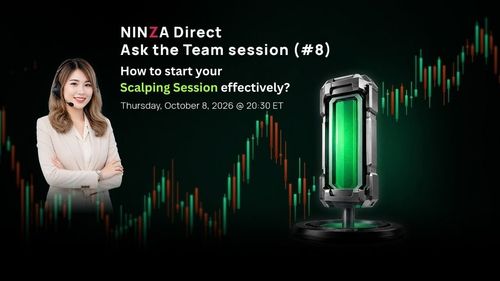
NINZA Direct: Ask the Team session (#8)
How to start your Scalping Session effectively?
_1791367956213.jpg)
FLAMINGO
One trading framework. Two ways to trade.
![[New flagship Renko system] Poseidon Trident —E](https://forestcms.nyc3.digitaloceanspaces.com/media/small_Poseidon Trident —E banner_1789461376412.jpg)
[New flagship Renko system] Poseidon Trident —E
Catch the Sniper Entry. Ride the Strongest Waves.

We hit the limits. So we built ZillaTrader.
A new research & trading platform, built on 12+ years of experience.
Coming November 2026.
What Is Risk Management in Trading?
Key takeaways
- Risk management in trading is the set of rules that control how much you can lose on any trade, any day, and across your whole account.
- The three pillars are position sizing, stop placement, and total exposure limits; together they decide your worst-case outcome before a trade starts.
- A common starting rule is risking a fixed small percentage of account equity per trade, often 1 to 2 percent, plus a hard daily loss limit.
- Regulators report that a large majority of retail traders lose money, which makes capital protection the first job of any serious trader.
- Automated tools that calculate size and enforce stops remove the moment of weakness where discipline usually breaks.
Risk management in trading is the set of rules that decide how much you can lose on a single trade, in a single day, and across your whole account before you ever click buy or sell. It is the part of trading that keeps a string of losses from ending your account, and it matters more than any entry signal or indicator you will ever use.
Most traders obsess over when to get in. The ones who survive obsess over how much they can lose when they are wrong. This article explains what risk management in trading actually involves: the three pillars that control your downside, how to set a sensible risk-per-trade and daily loss limit, the tools that enforce those limits automatically, and how to build a simple plan you can follow from your next session onward.
Defining risk management in trading for active traders
For an active futures or stock trader, risk management is a planning discipline, not a feeling. You answer three questions before entering any position: How much am I willing to lose on this trade? Where will I exit if I am wrong? How much total risk can be open across all my positions at once?
The reason this matters is simple. Trading outcomes are uncertain on any single trade, and losses are guaranteed over a career. Your edge, if you have one, only pays off across many trades. A single oversized loss can wipe out weeks of careful gains, so the goal is to keep every loss small enough that you stay in the game long enough for your edge to work.
The data on retail outcomes is sobering. The European Securities and Markets Authority found that between 74 and 89 percent of retail investor accounts lose money when trading contracts for difference, which is why EU brokers must display that disclosure on their marketing (ESMA). Those numbers are not a reason to quit. They are a reason to treat capital protection as your first job.
The three pillars: position sizing, stops, and exposure limits
Every durable risk framework rests on three pillars. Get these right and most other mistakes become survivable.
Position sizing
Position sizing answers how many contracts or shares you buy. It is the single most powerful lever you control, because it directly sets the dollar amount at risk. The core idea: decide the dollar risk you will accept first, then size the position to match that risk given your stop distance. Size is an output of your risk rule, not a gut choice.
If you trade futures, where contract values and tick sizes vary widely, getting size right by hand is error-prone. Our guide on how to calculate position size for futures trading walks through the math for common instruments.
Stops
A stop defines where you admit you were wrong and exit. Without a predefined exit, a losing trade has no natural end, and traders talk themselves into holding losers far past any sensible point. The stop should sit at a price that invalidates your trade idea, not at an arbitrary dollar figure that feels comfortable. The dollar risk then follows from the distance between your entry and that stop, multiplied by position size.
Exposure limits
Exposure limits cap how much total risk can be live at once. Three trades that each risk one percent of your account may feel small individually, but if they are correlated, say three long positions in related index futures, they can move together and hit you like a single three percent loss. Exposure limits keep your total open risk and your concentration in any one theme under control.
Risk-per-trade and daily loss limits explained
Two numbers turn the three pillars into a concrete routine: risk per trade and your daily loss limit.
Risk per trade is the maximum you will lose if a single trade hits its stop, expressed as a percentage of account equity. A widely used starting point among active traders is 1 to 2 percent per trade. On a 50,000 dollar account, a 1 percent rule means you never risk more than 500 dollars on one position. The appeal of a percentage is that it scales automatically. Risk shrinks in dollar terms when your account draws down, which slows the bleeding during a cold streak.
Daily loss limit is the maximum you will lose across all trades in a single session before you stop. This exists because losing trades tend to cluster, and because a bad morning triggers the worst behavior: revenge trading, oversizing to win it back, and abandoning your plan. A daily limit, for example three times your per-trade risk, forces you to walk away before a rough day becomes an account-threatening one.
These limits are worth taking seriously because persistence alone does not fix a lack of discipline. A study of individual investors in Brazilian equity futures found that 97 percent of those who day traded for more than 300 days lost money, net of costs (Current Market Valuation). Trading more did not turn losers into winners. Controlling losses is what buys you the time to find and keep an edge.
Tools that enforce discipline automatically
Knowing your rules and following them under pressure are different skills. The moment a trade moves against you, the part of your brain that agreed to a 500 dollar stop starts negotiating. This is where automation earns its place.
Useful risk tools do three jobs:
- Size the trade for you. You enter your account risk and stop distance, and the tool returns the exact contract or share count. No mental math under pressure, no fat-fingered oversizing.
- Place and hold the stop. The stop goes on with the entry, not after, so there is never a window where a position sits unprotected.
- Enforce account-level limits. When you hit your daily loss limit, the tool can block new orders or flatten positions, removing the option to keep digging.
For NinjaTrader users, this is exactly the gap that Ninza's position sizing and risk tools are built to close: they calculate size from your risk rule, attach protective stops automatically, and enforce daily limits so the plan holds when emotion says otherwise. Automation does not give you an edge, but it stops you from surrendering the one you have.
Building a simple risk plan you can follow
A risk plan fails when it is too complicated to follow at 9:30 in the morning. Keep yours short enough to recite from memory. Here is a template you can adapt in one sitting.
- Set your per-trade risk. Pick a percentage of account equity, often 1 percent to start, and convert it to a dollar figure. Write it down.
- Set your daily loss limit. Choose a hard ceiling, for example three losing trades or a fixed dollar amount, after which you are done for the day. No exceptions.
- Define your stop rule. Decide how you place stops, by chart structure, by a volatility measure, or by a fixed distance, so you never size a trade without knowing your exit first.
- Cap total exposure. Decide the maximum number of open positions and the maximum combined risk you will carry at once, and account for correlated instruments.
- Automate what you can. Use a position sizing calculator and automatic stop placement so the rules are enforced, not merely intended.
- Review weekly. Once a week, check whether you followed the plan, separate from whether you made money. Discipline and profit are different metrics, and only one of them is fully in your control.
Write these six items on a single card next to your screen. The plan that fits on a card is the plan you will actually run.
Your next step is concrete: before your next session, open your trading account, note its current balance, and calculate the exact dollar figure that 1 percent represents. That single number is the foundation of everything above, and it takes two minutes to set. Build the rest of the plan around it from there.
Frequently asked questions
What is risk management in trading in simple terms?
It is the practice of deciding, in advance, how much money you are willing to lose on a single trade and across a trading day, then using position sizing and stops to enforce those limits.
How much should I risk per trade?
Many active traders risk a fixed small percentage of account equity per trade, commonly 1 to 2 percent. The exact figure depends on your account size, strategy, and tolerance for drawdown.
What is a daily loss limit?
A daily loss limit is a maximum dollar or percentage amount you allow yourself to lose in one session. When you hit it, you stop trading for the day, which prevents a bad morning from becoming a catastrophic week.
Can software enforce risk rules for me?
Yes. Position sizing calculators, automated stop placement, and account-level lockouts can size trades and halt activity at preset limits, so your rules hold even when emotion pushes you to break them.
Download ~ 40 FREE indicators & reach more useful resources !!!
LIVE Intraday Trading | Stop chasing Early Entries. Let Timing guide your entry →

ninZa.co Indicators
0 online
_1787026707358.svg)
NINZA is an official member of NinjaTrader Ecosystem together with 600+ industry-leading professionals that provide traders with quality trading products & services.




even more payment methods
Quick Links
Instructions
Support
Resources & Information
© Copyright 2026 All Rights Reserved



Because software products may be copied and stored easily, we will NOT issue refunds of any kind. ALL SALES ARE FINAL & NON-REFUNDABLE!
Futures, foreign currency, and options trading contains substantial risk and is not for every investor. An investor could potentially lose all or more than the initial investment. Risk capital is money that can be lost without jeopardizing one's financial security or lifestyle. Only risk capital should be used for trading and only those with sufficient risk capital should consider trading. Past performance is not necessarily indicative of future results.
Hypothetical performance results have many inherent limitations, some of which are described below. No representation is being made that any account will or is likely to achieve profits or losses similar to those shown; in fact, there are frequently sharp differences between hypothetical performance results and the actual results subsequently achieved by any particular trading program. One of the limitations of hypothetical performance results is that they are generally prepared with the benefit of hindsight. In addition, hypothetical trading does not involve financial risk, and no hypothetical trading record can completely account for the impact of financial risk of actual trading. For example, the ability to withstand losses or to adhere to a particular trading program in spite of trading losses are material points which can also adversely affect actual trading results. There are numerous other factors related to the markets in general or to the implementation of any specific trading program which cannot be fully accounted for in the preparation of hypothetical performance results and all which can adversely affect trading results.
NinjaTrader® is a registered trademark of NinjaTrader Group, LLC. No NinjaTrader company has any affiliation with the owner, developer, or provider of the products or services described herein, or any interest, ownership or otherwise, in any such product or service, or endorses, recommends or approves any such product or service.