

NINZA Columbus Day Sale 2026 – Bundle Builder
The larger the bundle, the better the value
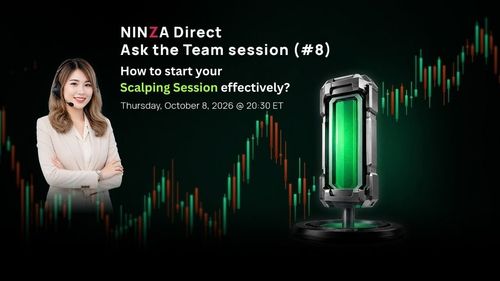
NINZA Direct: Ask the Team session (#8)
How to start your Scalping Session effectively?
_1791367956213.jpg)
FLAMINGO
One trading framework. Two ways to trade.
![[New flagship Renko system] Poseidon Trident —E](https://forestcms.nyc3.digitaloceanspaces.com/media/small_Poseidon Trident —E banner_1789461376412.jpg)
[New flagship Renko system] Poseidon Trident —E
Catch the Sniper Entry. Ride the Strongest Waves.

We hit the limits. So we built ZillaTrader.
A new research & trading platform, built on 12+ years of experience.
Coming November 2026.
How to Calculate Position Size for Futures Trading
Key takeaways
- Position size for a futures trade equals your dollar risk divided by (stop distance in ticks times the tick value of the contract).
- The E-mini S&P 500 (ES) moves $12.50 per tick, the Micro E-mini S&P 500 (MES) moves $1.25, so micros let you size risk ten times more precisely.
- Fix your dollar risk per trade first (many traders cap it at 1-2% of equity), then let the formula tell you how many contracts to trade.
- The most common account-killing mistake is choosing a contract count first and backing into a stop that is too tight to survive normal noise.
- A position sizing calculator removes the manual arithmetic so your contract count is correct before the order goes in, not after.
Position size in futures trading is the number of contracts you trade, and you calculate it by dividing the dollars you are willing to lose on the trade by the dollar risk of your stop. Get that one number right and a losing streak is survivable; get it wrong and a single trade can take a chunk of your account you cannot earn back quickly. This guide walks through the formula, works real examples for ES, NQ, and micro contracts, and shows where traders go wrong.
The appeal of futures is leverage. A single E-mini S&P 500 contract controls $50 of exposure for every index point, so a 20-point swing is $1,000 moving for or against you per contract. That leverage is exactly why sizing matters. The right question to ask before any trade is how many contracts keep your loss inside the limit you set, not how many contracts you can afford to buy.
Why Position Sizing Matters More Than Entries
Most new traders spend their energy hunting for better entries. The entry decides whether a trade wins or loses. Position size decides whether the account survives the trades that lose. Those are different jobs, and the second one does more to keep you in the game.
Think about a run of losers, which every method produces. If you risk a small, fixed slice of equity on each trade, ten losses in a row sting but leave you with plenty of capital to recover. If you size by gut feel and happen to be heavy on the trades that fail, the same ten losses can be fatal. The entries were identical. The sizing was not.
Regulatory disclosures from retail brokers paint a sobering picture: in any given quarter a large share of active retail accounts finish unprofitable. The traders who last are rarely the ones with the best entries. They are the ones whose losses stay small enough that a bad week is an inconvenience instead of an ending. Sizing is the mechanism that keeps losses small on purpose.
The Core Formula: Account Risk, Stop Distance, and Tick Value
The position size futures trading formula has three inputs and one output:
Contracts = Dollar Risk per Trade / (Stop Distance in Ticks x Tick Value)
Here is what each input means and how to set it.
Account risk: the dollar amount you decide to lose
Start with a dollar figure, not a contract count. Decide how much of your account you are willing to lose if this trade hits its stop. Many active traders cap this at 1-2% of account equity per trade, though the right number depends on your strategy and tolerance. On a $25,000 account, a 1% limit is $250 per trade. That $250 is the numerator in every calculation below.
Stop distance: how far price can move against you
Your stop distance is the gap between your entry and your stop-loss, measured in the contract's ticks. A tick is the smallest price increment the contract trades in. For the equity-index futures covered here, one tick is 0.25 index points, so a stop placed four points away is 16 ticks.
Tick value: the dollars each tick is worth
Tick value is where contracts differ, and it is the input traders most often get wrong. Each contract has a fixed dollar value per tick set by the exchange. According to the CME Group contract specifications for the E-mini Nasdaq-100 (NQ), the contract carries a $20 multiplier on the index, which puts each 0.25-point tick at $5.00. Multiply stop distance in ticks by this value and you have the dollar risk of a single contract. Divide your total risk budget by that per-contract risk and you have your contract count.
Worked Examples for ES, NQ, and Micro Contracts
Numbers make the formula concrete. These use a $250 risk budget per trade and the published tick values for each contract. NinjaTrader users will recognize all four symbols from the equity-index futures group.
Example 1: E-mini S&P 500 (ES)
The ES moves in 0.25-point ticks worth $12.50 each, with a full point equal to $50. Suppose you enter at 5,000.00 and place your stop at 4,996.00, a four-point stop. That is 16 ticks.
- Risk per contract: 16 ticks x $12.50 = $200
- Contracts: $250 / $200 = 1.25, rounded down to 1 contract
One ES contract risks $200, inside your $250 limit. Two contracts would risk $400, well over the limit, so you trade one.
Example 2: E-mini Nasdaq-100 (NQ)
The NQ tick is also 0.25 points but worth $5.00. The Nasdaq is a faster mover, so assume a wider 10-point stop, which is 40 ticks.
- Risk per contract: 40 ticks x $5.00 = $200
- Contracts: $250 / $200 = 1.25, rounded down to 1 contract
Example 3: Micro contracts (MES and MNQ)
Micro contracts are one-tenth the size of their E-mini counterparts. The Micro E-mini S&P 500 (MES) is worth $1.25 per tick, and the Micro E-mini Nasdaq-100 (MNQ) is worth $0.50 per tick. That smaller tick value is what makes micros useful for precise sizing.
Take the same four-point (16-tick) stop on the MES:
- Risk per contract: 16 ticks x $1.25 = $20
- Contracts: $250 / $20 = 12.5, rounded down to 12 contracts
Twelve MES contracts risk $240, far closer to your $250 target than the single ES contract managed. The micro lets you dial risk to the dollar instead of jumping in $200 steps. For a smaller account, or any time your ideal risk falls between full-size contract increments, micros are the tool that makes the math land where you want it.
| Contract | Tick size | Tick value | Point value |
|---|---|---|---|
| E-mini S&P 500 (ES) | 0.25 pts | $12.50 | $50 |
| E-mini Nasdaq-100 (NQ) | 0.25 pts | $5.00 | $20 |
| Micro E-mini S&P 500 (MES) | 0.25 pts | $1.25 | $5 |
| Micro E-mini Nasdaq-100 (MNQ) | 0.25 pts | $0.50 | $2 |
Common Sizing Mistakes That Blow Up Accounts
The formula is simple arithmetic. The failures come from skipping it or feeding it bad inputs.
Picking the contract count first. The most destructive habit is deciding "I'll trade three contracts" and then placing a stop wherever it fits the chart. That reverses the logic. Contract count is the output of the formula, not an input you choose by feel.
Setting the stop to fit the position instead of the market. When traders want more contracts than their risk budget allows, they often shrink the stop until the numbers work. A stop that tight gets hit by normal noise, so the trade fails even when the idea was right. Size down with micros instead of choking the stop.
Ignoring tick value differences. Treating an NQ contract like an ES contract, or a micro like a mini, throws the risk off by a factor of ten. The U.S. Commodity Futures Trading Commission stresses that understanding contract mechanics and leverage is a prerequisite before trading, and tick value is the mechanic that drives every sizing calculation.
Forgetting that losses compound downward. Risking a fixed percentage of equity means your dollar risk falls as the account shrinks, which protects you during a drawdown. Risking a fixed number of contracts regardless of balance does the opposite: the deeper the hole, the larger each loss is relative to what is left. The first approach is self-correcting; the second accelerates the damage.
Not accounting for correlated trades. Holding ES and NQ at the same time is close to doubling a single bet, because the two indexes move together. Two positions that each risk 1% can act like one 2% position. Size the basket, not just the individual trade.
Automating the Math With Position Sizing Tools
Doing this arithmetic by hand before every trade is where discipline breaks down. Markets move fast, and recalculating ticks, tick values, and contract counts under pressure invites errors right when they are most expensive. This is where a position sizing tool earns its place.
Ninza builds position sizing software for NinjaTrader that takes your account risk, reads the stop distance off your chart, and returns the correct contract count for ES, NQ, micros, or any other contract you trade. You set the risk percentage or dollar amount once; the tool handles the per-contract tick-value math and sizes the order so it is already correct when it goes in. Your judgment still picks the entries. The tool simply guarantees that the number of contracts behind each entry never exceeds the risk you decided to accept.
Whether you automate it or keep a calculator open beside the platform, the rule stays the same: fix the dollar risk first, let the formula set the contract count, and never let a tempting entry talk you into a larger position than the math allows. Decide on your risk-per-trade percentage today, run it through the formula on your next three setups, and watch how much calmer the trades feel when the size is settled before you click buy.
Frequently asked questions
What is the formula for position size in futures trading?
Contracts = dollar risk per trade divided by (stop distance in ticks times the dollar value per tick). Round down to the nearest whole contract so you never exceed your risk limit.
How much should I risk per futures trade?
There is no universal rule, but many active traders cap risk at 1-2% of account equity per trade. The point is to fix the dollar amount before you size the position, not after.
What is the tick value of an ES futures contract?
The E-mini S&P 500 (ES) moves in 0.25 index point ticks, and each tick is worth $12.50 per contract. A full one-point move equals $50.
Why trade micro futures instead of E-mini contracts?
Micro contracts are one-tenth the size of their E-mini counterparts, so each tick is worth far less. That smaller tick value lets smaller accounts hit an exact dollar risk target that a full-size contract would overshoot.
Download ~ 40 FREE indicators & reach more useful resources !!!
LIVE Intraday Trading | Stop chasing Early Entries. Let Timing guide your entry →

ninZa.co Indicators
0 online
_1787026707358.svg)
NINZA is an official member of NinjaTrader Ecosystem together with 600+ industry-leading professionals that provide traders with quality trading products & services.




even more payment methods
Quick Links
Instructions
Support
Resources & Information
© Copyright 2026 All Rights Reserved



Because software products may be copied and stored easily, we will NOT issue refunds of any kind. ALL SALES ARE FINAL & NON-REFUNDABLE!
Futures, foreign currency, and options trading contains substantial risk and is not for every investor. An investor could potentially lose all or more than the initial investment. Risk capital is money that can be lost without jeopardizing one's financial security or lifestyle. Only risk capital should be used for trading and only those with sufficient risk capital should consider trading. Past performance is not necessarily indicative of future results.
Hypothetical performance results have many inherent limitations, some of which are described below. No representation is being made that any account will or is likely to achieve profits or losses similar to those shown; in fact, there are frequently sharp differences between hypothetical performance results and the actual results subsequently achieved by any particular trading program. One of the limitations of hypothetical performance results is that they are generally prepared with the benefit of hindsight. In addition, hypothetical trading does not involve financial risk, and no hypothetical trading record can completely account for the impact of financial risk of actual trading. For example, the ability to withstand losses or to adhere to a particular trading program in spite of trading losses are material points which can also adversely affect actual trading results. There are numerous other factors related to the markets in general or to the implementation of any specific trading program which cannot be fully accounted for in the preparation of hypothetical performance results and all which can adversely affect trading results.
NinjaTrader® is a registered trademark of NinjaTrader Group, LLC. No NinjaTrader company has any affiliation with the owner, developer, or provider of the products or services described herein, or any interest, ownership or otherwise, in any such product or service, or endorses, recommends or approves any such product or service.